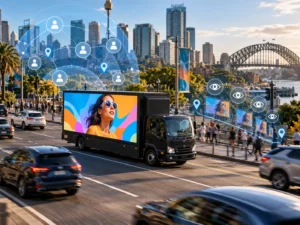
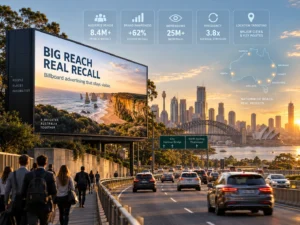
Mobile billboard reach tells you how broadly a campaign exposes the message, while frequency tells you how repeatedly the audience encounters it. Neither metric is automatically more important.
A broad awareness campaign may prioritise reach across several relevant areas. A local retailer, event promoter or service business may gain more from repeatedly appearing within a smaller, high-value catchment.
The strongest mobile billboard campaigns balance both. Reach introduces the campaign to enough relevant people. Frequency gives those people additional opportunities to notice, understand, and remember the message.
The important distinction is that mobile billboards can actively influence both through route planning, location selection, campaign timing, and repeated passes.
What Is Reach in Mobile Billboard Advertising?
Reach measures the number or proportion of different people who have an opportunity to see an advertising campaign during a defined period.
For mobile billboards, reach can increase when a route covers different suburbs, commuter corridors, shopping precincts, business districts or event environments.
Reach is not simply the number of kilometres travelled.
A truck covering a large geographic area can still generate weak campaign reach when the route contains relatively few members of the intended audience. A smaller route through locations with stronger audience concentration can create more meaningful exposure.
Reach therefore needs to be interpreted through audience relevance.
Mobile Marketing Australia combines route data with verified audience insights covering attributes such as age, gender and interests through its LUMOS Intelligence partnership. Heatmap-led planning can also help identify locations with stronger audience and campaign-performance signals.
This makes reach a question of who was available to see the campaign, not merely how far the vehicle travelled.
What Is Frequency in Mobile Billboard Advertising?
Frequency measures how often the average exposed person encounters the campaign.
A mobile billboard can build frequency by returning to the same valuable areas across different periods of the day or over several campaign days.
For example, a commuter can see the same campaign:
- during the morning journey to work;
- again while travelling home;
- later in the week along the same corridor;
- near a retail or entertainment precinct connected with the route.
Repeated exposure can strengthen familiarity because the audience receives more than one opportunity to process the message.
Frequency is particularly important where the first exposure may be brief. A person may initially notice only the brand colours or headline. Another encounter can reinforce the offer, product or call to action.
There is no universal number of exposures that makes every campaign effective. The appropriate frequency depends on the objective, audience behaviour, creative complexity and campaign duration.
Reach vs Frequency at a Glance
| Factor | Reach | Frequency |
| Main question | How broadly is the campaign being seen? | How repeatedly is the campaign being seen? |
| Primary purpose | Introduce the message to more relevant people | Reinforce the message with the same audience |
| Route approach | Broader geographic coverage | Repeated passes through selected areas |
| Strong fit | Large launches, awareness campaigns | Local campaigns, retail, events, familiarity |
| Main risk | Broad exposure with weak audience relevance | Too much repetition within a narrow audience |
| Measurement focus | Unique audience exposure | Average repeat exposure |
A strong media plan rarely treats these as competing metrics. Reach and frequency work together.
Why Reach Alone Does Not Tell You Whether a Campaign Is Strong
A large reach figure can look impressive while hiding weak audience relevance.
A campaign can pass through several high-traffic areas and expose the message to a substantial number of people. That activity becomes less useful when those people fall outside the intended customer group.
Audience composition therefore matters alongside volume.
A mobile billboard promoting a local professional service may perform better when it repeatedly operates around relevant business and commuter areas than when it travels across unrelated parts of a metropolitan market.
The same principle applies to retail, events and launches.
More exposure is useful only when the exposure occurs around people the campaign actually needs to influence.
This is why mobile billboard route planning needs to begin with audience behaviour rather than the busiest available roads.
Related: How to Choose Routes for Mobile Billboard Advertising Campaign
High Reach Is Not the Same as High Relevance
A campaign can appear in front of a large audience while still missing the people most likely to respond. Reach becomes more useful when route selection, audience concentration, and campaign objective are considered together.
Why Frequency Matters More Than a Single Exposure
One exposure creates an opportunity to notice the campaign. Repeated exposures create additional opportunities to recognise and remember it.
Outdoor advertising is often encountered within everyday movement. Drivers, passengers, pedestrians and commuters may see a billboard for only a limited period.
A repeated encounter can help the audience process more of the message over time.
Frequency becomes especially valuable when:
- the campaign runs within a defined local area;
- the same audience uses predictable commuter routes;
- a store or venue has a clear catchment;
- campaign activity is connected with a recurring event or destination;
- brand familiarity is an important objective.
The value comes from reinforcement rather than repetition for its own sake.
A weak advertisement does not automatically become effective because people see it more often. Creative still needs clear typography, a strong hierarchy, immediate branding and a message suited to the available viewing time.
The broader question of billboard advertising effectiveness therefore includes reach, frequency, creative quality, route relevance and measurement together.
Related: Is Billboard Advertising Effective?
When Should a Campaign Prioritise Reach?
Reach deserves greater priority when the campaign needs broad market exposure.
Product Launches
A new product can benefit from appearing across several relevant audience environments rather than concentrating entirely on one local area.
Major Brand Awareness Campaigns
Established or growing brands can use broader routes to increase the number of distinct people exposed to the campaign.
Multi-Location Businesses
Businesses operating several stores or service areas can use mobile routes to connect multiple catchments within one campaign.
Large Public Events
Campaigns promoting major events can use several related audience zones, transport corridors and entertainment areas to expand exposure.
A reach-focused strategy should remain selective. Broad geographic coverage works best when each route area has a clear connection with the target audience.
When Should a Campaign Prioritise Frequency?
Frequency becomes more important when repeated local exposure supports the campaign objective.
Store Openings
A new store can concentrate mobile billboard activity around nearby residential areas, commuter roads and shopping locations.
Local Service Businesses
Businesses serving a defined geographic area can repeatedly cover the same catchment rather than spreading activity across unrelated suburbs.
Event Campaigns
Repeated activity around venue approaches, transport points and relevant entertainment precincts can reinforce awareness before an event.
Short Promotional Windows
A concentrated campaign can prioritise repetition where the audience has only a limited period to notice and respond to the message.
The decision is not simply “reach or frequency.” Strong planning asks how much geographic breadth the campaign needs before additional repetition becomes more valuable.
How Mobile Billboard Routes Control Reach and Frequency
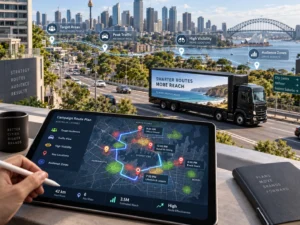
Mobile billboard routes are one of the strongest variables controlling the balance between reach and frequency.
A broad route can move through several suburbs and precincts. This can expose the campaign to a larger mix of people but reduce the number of repeated encounters within each location.
A focused route covers fewer areas but revisits the places with the strongest audience relevance.
A hybrid route can combine both.
For example, a campaign can repeatedly cover a primary retail catchment during the most valuable periods while using selected campaign windows to extend into secondary areas.
Route sequence also matters.
Morning activity may prioritise commuter corridors. Midday activity can shift towards commercial and retail areas. Evening activity can concentrate around hospitality, events or entertainment.
The route therefore controls more than geography. It determines who is exposed, when exposure occurs, and how often the audience can encounter the campaign.
How Audience Movement Changes Frequency
Frequency in mobile OOH does not work exactly like frequency in digital advertising.
Online advertising can repeatedly serve impressions to identifiable devices or accounts. Mobile outdoor advertising builds repetition through physical audience movement.
People follow routines.
Commuters use similar roads and transport routes. Shoppers return to retail precincts. Workers move through business districts. Event audiences approach and leave venues through predictable corridors.
Mobile billboard campaigns can use these movement patterns to create repeated physical exposure.
LUMOS Intelligence adds another layer to this planning for MMA campaigns by providing verified audience insights and heatmap-led location data. This can help identify where relevant audiences are concentrated and where campaign activity can be focused.
The resulting frequency is created by the relationship between the route and real-world human movement rather than by simply advertising more times.
Does More Frequency Always Produce Better Results?
More frequency does not automatically mean better advertising. Repeated exposure supports familiarity, but the message still needs to remain relevant and understandable.
A highly repetitive campaign can lose impact when:
- the creative never changes during a longer digital campaign;
- the route is too narrow for the objective;
- the same audience is exposed without a clear campaign purpose;
- the advertisement is difficult to understand;
- additional exposure is concentrated in lower-value periods.
Digital formats can help by rotating creative while maintaining consistent branding.
For example, one campaign can keep the same visual identity while changing product messages, event details, or calls to action at different times of the day.
The objective is consistent recognition without unnecessary creative stagnation.
How Creative Affects Reach and Frequency
Reach and frequency describe exposure. Creative determines what the audience can take from that exposure. A campaign can achieve broad reach while communicating almost nothing when the headline is too long or branding is difficult to identify.
Likewise, repeated exposure to confusing creative does not guarantee stronger recall.
Effective outdoor creative typically uses:
- one dominant idea;
- readable typography;
- strong contrast;
- immediate brand identification;
- short supporting copy;
- a simple call to action.
Mobile formats place additional pressure on typography because viewing distance and speed can change continuously.
The message needs to remain understandable across different street environments rather than only looking clear in an artwork preview.
For digital campaigns, Digital Mobile Billboards can rotate several creative executions while preserving the campaign’s core visual identity.
How Digital Mobile Billboards Change Frequency Planning
Digital mobile billboards allow creative changes without replacing a printed skin.
That flexibility can make frequency more useful because repeated exposure does not require showing precisely the same creative every time.
One campaign can rotate:
- brand messages;
- product variations;
- promotional messages;
- event information;
- time-sensitive creative;
- different calls to action.
The core brand remains recognisable while individual messages change according to campaign needs.
A breakfast-related message can appear during morning activity, while a different execution supports afternoon or evening audiences.
This approach combines physical repetition with contextual relevance.
A mobile digital billboard truck can therefore contribute to frequency at two levels: repeated brand exposure and repeated exposure to different campaign messages within the same broader creative system.
Related: What Is a Mobile Digital Billboard Truck?
Related: Static vs Digital Billboard
How Are Reach and Frequency Measured?
Reach and frequency need to be separated from basic delivery verification.
Campaign Delivery
Delivery confirms that the campaign ran where and when planned.
Mobile Marketing Australia uses GPS-tracked movement, route heat maps, and campaign photography. Clients also receive 20+ high-resolution campaign photos each campaign day.
This establishes where the truck operated.
Reach
Reach estimates how many different people had an opportunity to encounter the campaign.
Useful inputs can include:
- audience movement;
- route traffic;
- location data;
- visibility;
- campaign operating periods;
- verified audience information.
Frequency
Frequency estimates how often the exposed audience encountered the campaign over the measurement period.
Repeated routes, audience routines, campaign duration, and operating schedule all contribute to this metric.
MMA campaigns can use third-party verified reach and frequency reporting to provide a more structured view of campaign exposure.
What Is the Difference Between Impressions, Reach and Frequency?
Impressions, reach, and frequency describe different parts of campaign exposure.
| Metric | What It Measures |
| Impressions | Total opportunities for the campaign to be seen |
| Reach | Number or proportion of different people exposed |
| Frequency | Average number of exposures among the reached audience |
A campaign can generate deep impressions through broad exposure, repeated exposure, or a combination of both.
That is why impressions alone provide incomplete information. Two campaigns with similar total impressions can have very different audience structures. One may reach a large number of people once. Another may reach a shorter but highly relevant audience multiple times. Campaign objectives determine which pattern is more useful.
Reach and Frequency Are Not the Same as Results
Exposure metrics describe media delivery. They do not automatically prove business outcomes.
A campaign can reach the intended audience and still require separate measurement to determine whether behaviour changed.
Response indicators can include:
- branded search;
- campaign landing-page visits;
- QR-code scans;
- direct website traffic;
- tracked phone calls;
- enquiries;
- bookings;
- store visits;
- event attendance.
MMA’s LUMOS Intelligence partnership can also support retargeting across 2,000+ publishers or pass audience IDs back into a client’s internal ecosystem where the campaign setup supports it.
This creates a connection between physical outdoor exposure and subsequent digital activation.
Reach and Frequency Measure Exposure, Not Every Outcome
Reach shows how broadly the campaign was exposed. Frequency shows how repeatedly the audience encountered it. Neither metric alone proves enquiries, sales, or brand lift. Campaign response needs its own measurement framework.
Can QR Codes Help Measure Reach or Frequency?
QR codes measure direct interaction rather than total reach or frequency.
A person who scans a code has clearly engaged with the campaign, but a person can also see, remember and later act on a billboard without scanning anything.
QR data can be useful when combined with route and campaign information.
For example, separate QR destinations can help compare response across campaign periods, creative versions or selected route zones.
That information becomes more meaningful when analysed alongside GPS records, verified exposure reporting, website behaviour and enquiries.
The guide to QR codes in mobile billboard advertising explains how scan data can support this broader measurement approach.
Related: How to Use QR Codes in Mobile Billboard Advertising
Broad Reach vs Local Saturation: Which Strategy Is Better?
Neither strategy is universally stronger.
Broad reach makes sense when the advertiser needs to introduce the campaign across a larger geographic market.
Local saturation becomes more valuable where a defined catchment contains a large proportion of the intended audience.
Consider two different scenarios.
A national consumer brand launching a new product across Sydney can benefit from broad exposure across several audience environments.
A local gym opening one new location may gain more from repeated exposure within the surrounding suburbs, commuter routes and shopping areas.
The first campaign values geographic breadth. The second values repeated familiarity. Both can be effective because the media strategy matches the objective.
Mobile vs Static Billboard Reach and Frequency
Mobile and static billboards can create reach and frequency in different ways.
A static billboard builds frequency because the same commuters or residents repeatedly pass one location. A mobile billboard can build frequency by returning to several places where the target audience regularly moves.
Mobile campaigns can also extend reach by changing geography during the campaign. Static campaigns maintain consistent presence from one fixed site.
Neither method is inherently superior. The choice depends on whether the campaign values persistent site visibility, movable audience targeting, or a combination of both.
The full mobile billboards vs static billboards comparison explores those differences in greater detail.
How Campaign Duration Affects Reach and Frequency
Campaign duration determines how much time the media plan has to accumulate exposure.
A short event campaign may prioritise concentrated activity around a narrow time window.
A longer brand campaign can allow reach and frequency to build gradually across repeated audience movement.
More days do not automatically create a better campaign.
The route, audience, creative and operating periods still determine whether the additional exposure is useful.
Campaign duration should therefore follow the campaign objective.
A launch may require intense exposure around a defined date. Local awareness may benefit from sustained repetition. Event promotion can increase concentration as the event approaches.
The appropriate duration is the one that gives the campaign enough opportunity to reach relevant people and reinforce the message.
How to Decide the Right Reach and Frequency Balance
A practical decision starts with 5 questions.
1. How Large Is the Relevant Audience?
A broad target audience can justify wider geographic coverage.
2. How Concentrated Is the Audience?
A geographically concentrated audience can make repeated local exposure more valuable.
3. How Complex Is the Message?
Simple brand messages can register quickly, while unfamiliar products or new brands can benefit from reinforcement.
4. How Long Is the Campaign?
Short campaigns may require greater concentration. Longer campaigns create more opportunities to accumulate frequency.
5. What Is the Intended Outcome?
Mass awareness, local store traffic, event attendance, and lead generation create different media priorities. The strongest balance is therefore campaign-specific rather than based on one universal reach or frequency target.
Frequently Asked Questions
What Is Reach in Billboard Advertising?
Reach measures how many different people have an opportunity to see the campaign during a defined period.
What Is Frequency in Billboard Advertising?
Frequency measures how often the average reached person is exposed to the campaign.
Is Reach or Frequency More Important?
Neither is universally more important. Reach matters when the campaign needs broader exposure, while frequency becomes more valuable when repeated familiarity within a relevant audience matters.
How Do Mobile Billboards Build Frequency?
Mobile billboards can repeatedly cover selected commuter routes, retail areas, local catchments, and event environments where the same audience is likely to return.
Does a Larger Route Create More Reach?
A larger route can increase geographic coverage, but relevant audience reach depends on who actually moves through those locations.
Can a Mobile Billboard Have Too Much Frequency?
Excessive repetition can become less useful when the route is too narrow, the creative remains unchanged for too long, or additional exposures occur in low-value environments.
How Are Reach and Frequency Tracked?
Route movement, audience data, GPS records, heat maps, and third-party verified reach and frequency reporting can be combined to assess campaign exposure.
Are Impressions the Same as Reach?
No. Impressions count total opportunities to see the campaign. Reach estimates the number of different people exposed. Frequency describes the average number of exposures among those people.
Plan for Recognition, Not Just Exposure
A mobile billboard campaign becomes more useful when reach and frequency are designed around real audience behaviour rather than treated as headline numbers after the campaign ends.
Mobile Marketing Australia combines GPS-tracked routes, verified reach and frequency reporting, LUMOS Intelligence audience insights and heatmap-led planning to help campaign activity focus on the locations and audiences that matter.
Explore Digital Mobile Billboards to build a campaign around relevant reach, meaningful repetition, and measurable delivery.