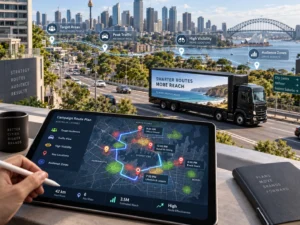
QR codes in mobile billboard advertising can turn physical outdoor exposure into a direct digital action, but the audience needs enough time and a safe opportunity to scan.
A QR code displayed near pedestrians, event attendees or people waiting in a shopping precinct creates a very different interaction from a code passing fast-moving road traffic. Movement, viewing distance, route conditions, creative design and the destination page all affect whether scanning is practical.
For QR codes in mobile billboard advertising in Australia, campaign planning therefore needs to connect the billboard, audience behaviour, route, call to action, landing page and measurement process from the start.
Do QR Codes Work in Mobile Billboard Advertising?
QR codes in mobile billboard advertising work when viewers can notice the code, understand what it offers, and scan it safely within the available viewing window.
The QR code itself does not make a mobile billboard interactive. Audience context creates the interaction opportunity.
A campaign operating around an event queue can give people time to see the advertisement and respond. A digital walking board moving through a pedestrian precinct can create another suitable environment. A truck travelling through faster vehicle traffic provides a shorter interaction window.
The useful question is therefore not simply whether the QR code is visible. Campaign planners need to ask whether the intended audience can realistically interact with it.
This distinction is particularly important for mobile billboard advertising in Australia, where campaigns can move through CBDs, shopping areas, suburban centres, entertainment precincts and event environments with very different viewing conditions.
When Does a QR Code Make Sense on a Mobile Billboard?
Mobile billboard QR codes make the most sense where audiences have realistic dwell time and safe access to their phones.
Strong environments include:
- pedestrian precincts where people move at walking speed;
- shopping areas where audiences stop or queue;
- event approaches where attendees gather before entry;
- entertainment precincts with pedestrian activity;
- activations where the display remains around a defined audience;
- locations where people are already waiting.
These environments create a stronger connection between exposure and action because the audience has time to process the message.
A QR code has less practical value where both the vehicle and viewer are moving rapidly. Campaign creative should never depend on motorists interacting with a phone while driving.
The QR code should therefore match audience behaviour rather than simply occupy available advertising space.
How Movement Affects Mobile Billboard QR Codes
Mobile billboard QR codes have a different scan environment from codes displayed on fixed posters, packaging or stationary screens.
Movement affects four parts of the interaction.
Viewing Time
A moving truck can remain visible for a limited period. The audience needs enough time to recognise the advertisement, identify the QR code and decide whether to engage.
Viewing Distance
Greater distance makes the code occupy less of the viewer’s field of vision. QR size, display resolution and surrounding creative all affect scanability.
Audience Movement
Pedestrians, stationary event attendees, and people waiting in public spaces have different engagement opportunities from moving road users.
Repeat Exposure
A planned mobile billboard route can return to relevant areas during a campaign. Repeated exposure can give an audience another opportunity to notice the message or scan the code.
The route should account for these conditions when QR response forms part of the campaign objective.
Choose Routes Where People Can Actually Scan
Route selection changes when QR interaction becomes an important campaign response.
A standard awareness route can prioritise audience reach and repetition. A QR-led campaign also needs locations where the audience has a practical opportunity to respond.
Shopping precincts, event zones, pedestrian areas and waiting environments can provide stronger scan conditions because audiences spend more time around the display.
Route planning should still start with audience relevance. A busy pedestrian area offers limited campaign value when the people present do not match the intended market.
Mobile Marketing Australia also uses heatmap-led planning through its partnership with LUMOS Intelligence. Campaign data can identify higher-performing locations and help concentrate activity where audience and performance signals are stronger.
For Australian campaigns, the best scanning environment therefore combines relevant audience concentration with sufficient viewing time.
How Large Should a Billboard QR Code Be?
There is no universal QR-code size that works across every mobile billboard campaign.
Required size depends on viewing distance, screen dimensions, movement, display resolution, and the amount of surrounding creative.
A code that scans successfully on a designer’s computer monitor does not prove it will perform from street level.
Campaign testing should use:
- the actual display format;
- realistic viewing distances;
- multiple smartphone cameras;
- the intended creative;
- representative outdoor viewing conditions.
Testing becomes particularly important for digital trucks because screen size and brightness do not remove the effects of distance or movement.
The practical standard is simple: the QR code needs to scan reliably under the conditions in which the intended audience is expected to see it.
Make QR Codes on Billboards Easy to Identify
QR codes on billboards need strong visual separation from the rest of the advertisement.
A scanable code can still fail to attract interaction when it disappears inside a crowded layout.
Effective presentation uses clear contrast between the QR code and its background, sufficient clear space around the code, and limited competing information nearby.
The code should also fit within the billboard’s visual hierarchy. Viewers need to process the primary message first, understand the reason to interact, and then recognise the QR code as the next step.
For QR codes on billboards in Australia, outdoor conditions also change throughout the campaign. Bright daylight, surrounding signage, viewing angle and street-level visual clutter can all affect how easily the code is identified.
Real-world creative testing provides a stronger basis than judging scanability from an artwork file alone.
Give People a Clear Reason to Scan
A QR code needs an explicit purpose.
“Scan me” describes an action but gives the viewer little information about what happens next.
Stronger calls to action explain the outcome, such as:
- Scan for tickets
- Scan to book
- Scan for event details
- Scan to learn more
- Scan to view the campaign offer
The call to action needs to match the destination exactly.
An event advertisement promising ticket access should open the relevant ticket experience. A booking campaign should lead directly towards booking. A product campaign should continue with the specific product or promotion shown on the billboard.
QR response becomes easier when the physical advertisement and digital destination feel like one connected campaign.
Send Scanners to the Right Mobile Landing Page
The landing page should continue the billboard message immediately.
A QR user has already completed one action by scanning the code. Additional unnecessary navigation adds friction between interest and the intended response.
A suitable destination provides:
- fast mobile loading;
- immediate message continuity;
- clear campaign branding;
- one obvious next action;
- minimal unnecessary navigation.
A campaign promoting an event should direct visitors towards the event information or ticket page rather than a general homepage.
The same principle applies to retail campaigns, bookings, launches and lead-generation activity.
Landing-page continuity helps preserve the intent created by the mobile billboard instead of asking the visitor to search for the relevant information after scanning.
Use Separate QR Codes When Campaign Measurement Requires It
Different QR codes can help separate responses across campaign variables.
Useful segmentation can include different creative versions, campaign periods, route groups, or locations.
For example, one campaign could assign separate trackable QR destinations to an event-focused route and a retail-focused route. Scan activity can then be assessed alongside the operating periods for each area.
Segmentation needs a clear measurement purpose. Creating a different code for every minor campaign variation can produce fragmented reporting without adding meaningful insight.
The reporting structure should therefore be decided before deployment.
Campaign planners first define what they want to compare, then configure the codes required to make that comparison possible.
How Billboard QR Code Tracking Works
Billboard QR code tracking records direct interactions generated through a trackable QR destination.
Depending on the campaign setup, reporting can include scan volume, scan timing, campaign source, and activity on the destination page. Conversion actions can also be assessed where the landing-page tracking configuration supports them.
For billboard QR code tracking in Australia, scan data becomes more useful when it is interpreted alongside the physical campaign.
Mobile Marketing Australia campaigns use GPS-tracked movement, route heat maps and campaign photography to verify where advertising activity occurred. LUMOS Intelligence adds verified audience insights covering age, gender and interests, providing additional context around the audiences reached by the campaign.
QR activity can therefore be reviewed alongside route and audience information rather than treated as an isolated metric.
The LUMOS partnership also supports retargeting across 2,000+ publishers. Audience data can alternatively pass back through ID pass-back into a client’s internal ecosystem, connecting mobile outdoor exposure with subsequent digital campaign activity.
This creates a broader measurement and activation framework:
QR interaction > route data > audience insight > landing-page behaviour > retargeting or internal audience activation.
What QR Code Scans Can and Cannot Tell You
QR scans measure direct interaction. They do not represent every person influenced by the billboard.
Scan data can help identify:
- which QR CTA produced interaction;
- which campaign period generated response;
- which code or route group received scans;
- how users behaved after reaching the landing page.
Scan data alone does not establish total campaign reach, total attention, brand recall, or every later conversion.
A person can see a mobile billboard, remember the brand and search for it hours later without scanning. Another person can visit a store after repeated billboard exposure. Neither response necessarily appears in the QR report.
Campaign measurement should therefore combine direct-response data with broader evidence.
MMA campaigns include GPS tracking, heat maps, 20+ high-resolution campaign photos each day, and verified reach and frequency reporting. LUMOS Intelligence adds verified audience insights and heatmap-led planning that can help identify locations generating stronger campaign signals.
The strongest interpretation uses QR scans as one response metric within the wider mobile OOH measurement framework.
How QR Codes Can Support Retargeting After Outdoor Exposure
Mobile billboard advertising can continue digitally after the physical exposure has occurred.
A QR scan creates a direct pathway from the street to a digital destination. Campaign tracking can then support subsequent digital activity where the appropriate technology, permissions, and campaign setup are in place.
Through LUMOS Intelligence, MMA campaigns can support retargeting across more than 2,000 publishers. ID pass-back can also feed relevant audience information into a client’s internal ecosystem for further activation.
This matters because outdoor exposure and final conversion can occur at different points in the customer journey.
A person can encounter the billboard at an event, scan for more information, revisit the brand through subsequent digital activity, and complete the intended action later.
QR codes therefore work best as part of a connected campaign rather than as a standalone scan counter.
Common Mistakes With QR Codes on Mobile Billboards
QR campaigns lose practical value when execution ignores the viewing environment.
Making the Code Too Small
A technically valid QR code still needs to remain usable from realistic street-level viewing distances.
Choosing Routes With Weak Scan Opportunities
Fast-moving environments give audiences less time to process and interact with the code.
Using an Unclear CTA
The viewer needs to understand what scanning provides.
Sending Traffic to a Generic Homepage
The destination needs to continue the specific campaign message.
Crowding the Creative
The QR code, headline, brand, and CTA need a clear hierarchy.
Measuring Success Through Scans Alone
QR interactions represent direct response, not total campaign effectiveness.
Skipping Real-World Testing
Artwork needs to be tested under realistic display, distance, and movement conditions before launch.
Example: QR Codes in Mobile Billboard Advertising in Australia
Consider an Australian event promoter using QR codes in mobile billboard advertising in Australia to drive visits to a ticket page.
The campaign focuses on an entertainment precinct where the target audience travels on foot and spends time around hospitality and event locations.
The creative uses a short event headline, recognisable branding, a visible QR code and the CTA “Scan for tickets”.
The QR destination opens directly to a mobile ticket page.
A campaign-specific trackable code records direct interactions. GPS data verifies truck movement, while heat maps and LUMOS Intelligence audience insights provide context around the locations and audiences reached.
Scan activity can then be reviewed alongside landing-page behaviour, branded search, route information and ticket-page actions.
The example demonstrates the key principle: QR execution, route strategy, audience behaviour and measurement work as one system.
Frequently Asked Questions
Do Mobile Billboard QR Codes Work?
Mobile billboard QR codes work where the audience has sufficient time, visibility and a safe opportunity to scan. Pedestrian areas, event environments, shopping precincts and waiting locations can provide stronger engagement conditions.
Can Someone Scan a QR Code From a Moving Billboard?
Scanning is possible under suitable viewing conditions, but campaign planning should never rely on active drivers interacting with mobile devices. Pedestrian and stationary audiences provide safer response opportunities.
How Large Should QR Codes on Billboards Be?
QR codes on billboards need to be large enough for their intended viewing distance and display conditions. Real-world testing is required because movement, resolution, creative layout, and distance vary between campaigns.
What Should a Billboard QR Code Link To?
A billboard QR code should link directly to the campaign-specific mobile destination promised by the CTA, such as an event page, booking page, product page, or dedicated campaign landing page.
Can Billboard QR Code Tracking Measure the Whole Campaign?
Billboard QR code tracking measures direct scan interaction. Total campaign assessment also needs delivery, reach, frequency, website activity, search behaviour and other response metrics relevant to the campaign objective.
Do QR Codes Work Differently in Mobile Billboard Advertising in Australia?
Route conditions, pedestrian activity, events, viewing distance and audience movement affect scan opportunities in every market. Mobile billboard advertising in Australia should therefore match QR execution to the specific Australian locations and audiences selected for the campaign.
Turn Outdoor Attention Into a Connected Digital Journey
QR strategy works best when the physical campaign is planned around what happens after the audience notices the message. Route selection creates the engagement opportunity, creative explains the action, the landing page continues it, and campaign data provides the context needed to interpret response.
Mobile Marketing Australia combines digital mobile billboard campaigns with audience-led planning, GPS-tracked delivery, LUMOS Intelligence data and connected digital activation.
Explore Digital Mobile Billboards and let’s get your brand moving.