Mobile billboards move advertising between selected locations, while static billboards build repeated visibility from one fixed site. Neither format is automatically better. The stronger choice depends on campaign objective, audience, geography, timing, duration, and creative requirements.
Comparing mobile billboards vs static billboards therefore requires more than asking which attracts more attention. Modern mobile billboard campaigns can also incorporate audience insights and location intelligence, allowing advertisers to evaluate not only where a campaign travels but who it is reaching and which locations create the strongest opportunities.
What Is the Difference Between Mobile and Static Billboards?
A mobile billboard carries advertising on a truck, trailer, or other moveable format, while a static billboard remains fixed in one location. One moves the media towards the audience. The other relies on audience movement past the media.
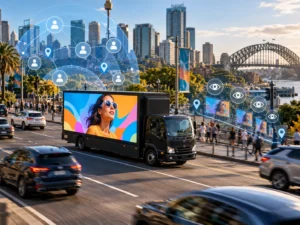
Both formats can be printed or digital. A mobile digital billboard truck uses LED screens, while traditional mobile billboards use printed creative. Fixed billboards can also use either printed panels or digital displays.
“Mobile” describes movement. “Static” describes location.
Mobile Billboards vs Static Billboards at a Glance
| Factor | Mobile Billboard | Static Billboard |
| Location | Moveable | Fixed |
| Targeting | Route, timing, and audience-informed planning | Site selection and location-based exposure |
| Measurement | GPS delivery tracking, heat maps, audience insights and response data | Audience exposure analysis and campaign response measurement |
| Frequency | Route dependent | Strong repeated exposure |
| Flexibility | High | Lower |
| Event targeting | Strong | Depends on site |
| Long-term presence | Campaign dependent | Strong |
| Best fit | Launches, events, local bursts | Continuous visibility |
Where Mobile Billboards Have the Advantage
Mobile billboards are strongest when campaign geography or timing needs to change.
Geographic flexibility allows one campaign to cover commuter corridors, retail precincts, business districts and event areas. Route planning can reflect where a target audience lives, works, shops and travels. Through verified audience insights, campaigns can also better understand whether selected locations align with the intended audience profile.
Short campaign bursts also suit mobile formats. Store openings, product launches, events, seasonal promotions and local campaigns can build concentrated visibility during a defined period.
Route and schedule flexibility also allow activity to follow audience behaviour. A campaign can focus on commuter areas during peak periods before moving towards shopping, commercial or entertainment precincts later in the day.
These advantages matter most when where and when the audience encounters the advertisement forms part of the strategy.
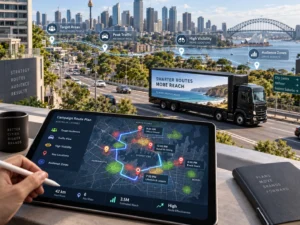
Heatmap-led planning strengthens this approach by identifying stronger-performing locations and helping campaign activity focus on areas with higher audience opportunity rather than relying only on general traffic volume.
Where Static Billboards Have the Advantage
Static billboards are strongest when persistent presence and repeated exposure matter.
A fixed billboard remains visible from one site throughout the campaign period. People travelling the same route can encounter the message repeatedly, strengthening familiarity when that location reaches the intended audience.
Static formats therefore suit campaigns where long-term awareness and location consistency matter more than mobility. A strategically selected commuter route, retail area or CBD location can create continuing brand presence over an extended period.
Prominent sites can also become highly recognisable parts of the surrounding environment, making the location itself part of the advertising strategy.
Reach vs Frequency: A Key Difference
Reach describes how broadly advertising is seen, while frequency describes how repeatedly the same audience sees it.
Mobile billboards can broaden geographic reach by moving through multiple areas. Static billboards can create strong frequency among commuters, residents, or visitors repeatedly passing the same location.
Neither metric is automatically more valuable.
A local business can gain greater value from repeated exposure within the right catchment than from reaching a larger audience once. A product launch operating across several precincts can place greater value on broader geographic exposure.
The campaign objective determines which balance matters.
Which Offers Better Audience Targeting?
Both formats target audiences geographically, but they do it differently.
Mobile billboards can target by:
- Route
- Suburb
- Time
- Event
- Commercial Precinct
- Local Catchment
Mobile campaigns can also incorporate verified audience insights covering age, gender and interests, adding audience context alongside route and location planning.
Static billboards target through site selection. Advertisers consider traffic flow, surrounding demographics, nearby destinations and audience travel patterns when selecting a location.
Mobile targeting is dynamic. Static targeting is site-based.
A mobile campaign can alter where exposure happens throughout the day. A static campaign concentrates exposure around one selected environment.
Both approaches can be precise when campaign geography is properly matched with audience behaviour. Mobile campaigns add additional flexibility by combining route movement, audience insights and location intelligence.
Which Is Better for Short-Term vs Long-Term Campaigns?
Mobile billboards tend to suit short, concentrated activity, while static billboards tend to suit sustained location visibility.
Mobile formats fit campaigns such as:
- launches;
- events;
- store openings;
- promotional periods;
- local advertising bursts.
Static formats fit longer campaigns where recurring commuter exposure, long-term recognition or continuous visibility around one strategic location is important.
Campaigns can also combine both formats. Static media can establish continuing background visibility while mobile advertising adds concentrated exposure around an important launch, event or promotional period.
The campaign duration should therefore follow the advertising objective rather than determine the format by itself.
Which Format Gives More Creative Flexibility?
Creative flexibility depends on whether the billboard is printed or digital.
A mobile digital billboard can rotate multiple advertisements, display motion, and change messaging throughout a campaign. A traditional mobile billboard normally carries one printed creative.
A fixed digital billboard can also rotate electronic content, while a printed fixed billboard maintains one creative.
The accurate comparison is therefore mobile or fixed, and printed or digital.
Mobile does not automatically mean digital, and static does not automatically mean printed.
Digital mobile formats become particularly useful where different creatives need to appear according to time, location or campaign stage.
Which Gets More Attention?
Attention depends on creative quality, location, context, audience and viewing opportunity rather than billboard type alone.
Mobile billboards can stand out through movement, physical scale and appearance across different environments.
Static billboards can command attention through prominent positioning, large-format presence, repeated familiarity and continuous visibility.
Strong creative remains essential for both formats. Audience insights and location intelligence can further improve planning decisions by helping advertisers understand where and when attention opportunities are strongest. Effective outdoor advertising commonly uses:
- large typography;
- strong visual contrast;
- simple messaging;
- recognisable branding;
- one clear action.
The strongest media placement can still underperform when the creative takes too long to understand.
How Do You Measure Mobile and Static Billboard Campaigns?
Mobile campaigns can use GPS routes, heat maps, operating records and campaign photography to verify delivery. Through Mobile Marketing Australia’s partnership with LUMOS Intelligence, campaigns can also use verified audience insights covering age, gender and interests alongside third-party verified reach and frequency reporting.
Response indicators can include:
- QR Scans
- Campaign Landing-Page Visits
- Promo-Code Use
- Website Traffic
- Branded Searches
- Phone Calls
- Enquiries
- Store Visits
- Event Attendance
Campaign activation can also continue beyond outdoor exposure. Relevant audiences can be retargeted across 2,000+ publishers, while ID pass-back can connect audience data with the advertiser’s internal ecosystem for further activation.
Static campaigns can also be assessed against campaign response, audience exposure and changes in relevant business metrics.
Neither format should be judged only by impressions.
Delivery verification, audience understanding and response measurement should be considered separately because each answers a different campaign question. A brand-awareness campaign, store-opening campaign and event promotion have different objectives, so measurement needs to reflect the result each campaign was designed to influence.
Mobile Billboard or Static Billboard: Which Should You Choose?
Choose a mobile billboard when:
- your audience moves across several relevant locations;
- timing matters;
- an event or launch creates a defined opportunity;
- a concentrated short-term burst is required;
- route flexibility adds value;
- local-area targeting needs to change during the campaign.
Choose a static billboard when:
- one location has strategic value;
- continuous visibility matters;
- repeated exposure is important;
- the campaign runs for longer;
- the selected site consistently reaches the target audience.
Use both when persistent awareness and concentrated campaign activity need to work together.
The decision becomes clearer when the campaign objective is defined first.
Mobile vs Static Billboards in Australia
Australian advertising environments range from CBD commuter corridors and suburban retail precincts to entertainment districts, major events and regional centres.
The better format depends on where the audience moves, when they are present, and what the campaign needs to achieve.
Mobile routes can adapt activity across different audience environments. Static billboards can establish sustained visibility around valuable locations.
Campaign planning should therefore start with audience behaviour, verified audience insights, location performance and media objectives before the format is selected.
Frequently Asked Questions
Are Mobile Billboards Better Than Static Billboards?
Mobile billboards are better when mobility, timing, and route flexibility matter. Static billboards are better when persistent location presence and repeated exposure matter.
Which Billboard Format Reaches More People?
Reach depends on the mobile route, static site, campaign duration, and audience movement. Mobile billboards can cover several areas, while static billboards repeatedly reach people passing one location.
Are Mobile Billboards Better for Local Advertising?
Mobile billboards can be highly effective for local advertising because routes can concentrate activity around specific suburbs, catchments and commercial precincts. A well-positioned static billboard can also provide strong local visibility from one strategic site.
How Do Mobile Billboard Campaigns Understand Their Audience?
Mobile billboard campaigns can combine route data with verified audience insights. Through Mobile Marketing Australia’s partnership with LUMOS Intelligence, campaigns can use verified age, gender, and interest insights to better understand the audience associated with campaign exposure.
Are Static Billboards Still Effective?
Static billboards remain effective where a strong location delivers continuous and repeated exposure to a relevant audience.
Can Mobile and Static Billboards Be Used Together?
Yes. Static media can establish ongoing visibility while mobile media adds concentrated exposure around selected locations, audiences, and campaign periods.
What Is the Difference Between a Static Billboard and a Digital Billboard?
Static describes whether the billboard remains in one location. Digital describes how the advertisement is displayed. A fixed billboard can therefore be either printed or digital.
Choose the Format Around the Campaign
The strongest billboard strategy starts with the audience and objective. Mobile billboards provide route, timing, geographic flexibility and audience-informed campaign planning. Static billboards provide persistent visibility and strong frequency from a selected site.
For campaigns where mobility, flexible audience targeting and measurable campaign activation matter, explore Digital Mobile Billboards with Mobile Marketing Australia. Let’s get your brand moving.