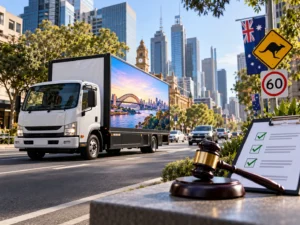
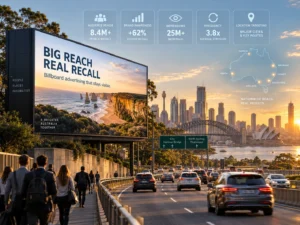
Mobile billboard advertising puts large-format outdoor media on the move, allowing brands to take a campaign through the streets, precincts and events where their audience is already present.
In Australia, campaigns can be planned around commuter corridors, shopping areas, CBDs, suburban catchments, entertainment precincts and major events rather than relying on one fixed advertising site.
Mobile billboard advertising combines the physical impact of out-of-home advertising with route planning, flexible scheduling and measurable delivery.
This guide explains the available formats, how campaigns work, route planning, creative strategy, measurement and the situations where mobile outdoor advertising makes the most sense.
What Is Mobile Billboard Advertising?
Mobile billboard advertising is outdoor advertising displayed on a moving or relocatable vehicle, trailer, bike, or pedestrian-carried format. Mobile billboard trucks are the best-known example, with large static panels or digital LED screens carrying advertising through selected locations.
Mobile billboards differ from conventional vehicle wraps because the advertising unit is designed primarily as media inventory. Campaign routes, operating times and target locations are selected around the advertiser’s objective and audience.
Australian mobile outdoor formats include printed trucks, digital trucks, solar ad trailers, relocatable billboards, bike boards and walking boards.
How Does Mobile Billboard Advertising Work in Australia?
A mobile billboard campaign follows 7 stages from objective to reporting:
- Define the campaign objective, such as awareness, event attendance, retail traffic or product launch visibility.
- Identify the target audience and the locations that matter to them.
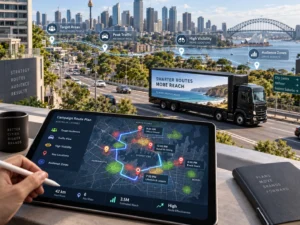
- Select routes and operating periods around commuter movements, retail activity, events or local catchments.
- Choose the advertising format based on campaign duration, creative requirements and environment.
- Develop outdoor-first creative that communicates quickly at street level.
- Deploy and track the campaign across the agreed route and schedule.
- Review delivery and response data after the campaign.
Mobile Marketing Australia campaigns use GPS-tracked movement, route heat maps, third-party verified reach and frequency reporting, and 20+ high-resolution photos per campaign day as proof of on-street delivery.
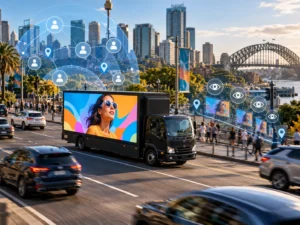
Through Mobile Marketing Australia’s partnership with LUMOS Intelligence, campaign planning can also be supported by verified audience insights covering age, gender and interests. This adds audience context alongside physical delivery data, helping advertisers understand not only where campaigns travelled, but the audience profile associated with campaign exposure.
Types of Mobile Billboard Advertising
Mobile outdoor media includes different formats for different audiences, environments, and campaign objectives.
Static Mobile Billboards
Traditional mobile billboards use printed vinyl artwork mounted to a truck. A fixed creative keeps one message visually consistent throughout the campaign.
Static mobile billboards suit campaigns built around one strong offer, brand message or creative concept.
Digital Mobile Billboards
Digital mobile billboards use high-brightness LED screens with rotating creative. Mobile Marketing Australia’s digital trucks provide 20m² of P4 LED screen space across three sides.
Digital creative allows multiple messages, scheduled artwork and real-time updates within one campaign. Advertisers wanting to understand the format in more detail can explore Digital Mobile Billboards and see how LED screens, rotating creative and mobile route planning work together.
Solar Ad Trailers and Relocatable Billboards
Solar ad trailers provide off-grid advertising that can remain in a selected location or move between locations. Relocatable billboards provide two-sided trailer-mounted advertising suited to longer-term roadside and location-specific visibility.
Smaller Street-Level Formats
Bike boards and walking boards take advertising into pedestrian environments where larger vehicles are less practical.
Digital bike boards, digital walking boards and static alternatives suit festivals, activations, nightlife areas, retail precincts and event environments.
Why Do Mobile Billboards Get Attention?
Movement, physical scale and location flexibility give mobile billboards a strong presence in public environments.
A campaign can travel through multiple audience zones during one operating period and create repeat exposure across places people visit as part of their normal routine.
Media planners distinguish between two important measures:
- Reach describes how broadly an audience is exposed to the campaign.
- Frequency describes how repeatedly an audience encounters the message.
Route planning can support both by covering relevant audience locations and returning to priority areas at relevant times. Heatmap-led planning adds another layer by identifying the locations generating stronger campaign opportunities, helping activity focus on the highest-performing areas rather than relying only on general traffic volume.
Context also matters. A retail campaign travelling around shopping precincts or an event campaign appearing around a venue places the advertising close to the activity it is promoting.
Mobile Billboards vs Fixed Billboards
The main difference is that mobile billboards move with the campaign strategy, while fixed billboards depend on traffic passing one location.
Both formats can support outdoor awareness, but their planning strengths differ.
| Factor | Mobile Billboard | Fixed Billboard |
| Location | Route can change | One fixed site |
| Targeting | Route, time and audience-informed planning | Primarily based on fixed site characteristics |
| Short campaigns | Strong fit | Depends on inventory |
| Event targeting | Can follow event geography | Depends on nearby sites |
| Exposure pattern | Multiple locations | Repeated exposure at one site |
Mobile campaigns fit objectives where where and when the audience gathers matters to the outcome. Fixed OOH suits objectives centred on sustained visibility at one established location.
A deeper comparison is available in our guide to why brands are choosing mobile billboards over traditional advertising.
How Are Mobile Billboard Routes Planned?
Effective route planning starts with audience behaviour rather than simply selecting the busiest road on a map.
Campaign planners consider where the target audience:
- lives;
- works;
- shops;
- commutes;
- attends events;
- spends leisure time.
Movement is then aligned with the campaign objective.
Morning routes can prioritise commuter corridors and business districts. Midday activity can shift towards retail precincts and commercial centres. Evening routes can concentrate around entertainment areas, hospitality precincts or events.
Route planning also considers dwell opportunities, traffic patterns, campaign hours and repeat exposure.
GPS tracking and heat maps provide a record of where the campaign travelled, allowing delivery to be verified against planned activity. Through heatmap-led planning, campaign teams can also identify stronger-performing locations and adjust route decisions around areas with higher audience opportunity.
How Long Should a Mobile Billboard Campaign Run?
Campaign duration should follow the objective and the frequency required to influence the target audience.
A short campaign burst can support a product launch, event, store opening or time-sensitive promotion. Repeated campaign days can build greater familiarity within a local market. Extended activity can support sustained awareness across a longer promotional period.
Duration should therefore be considered alongside route coverage and frequency rather than in isolation.
An event campaign can require concentrated exposure around specific dates, while a broader brand-awareness campaign can benefit from repeated visibility over a longer period.
How Should Mobile Billboard Creative Be Designed?
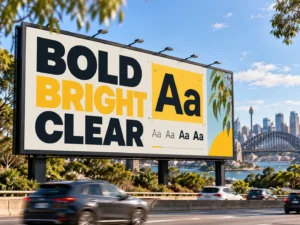
Mobile billboard creative needs to communicate in seconds. Six principles keep the message clear:
- Lead with one core idea. A billboard works best as a focused message rather than a brochure.
- Use a short headline. Large typography makes the main point readable from a distance.
- Build a clear hierarchy. Headline, brand, and action should appear in an obvious order.
- Create strong contrast. Text and key visuals need clear separation from the background.
- Use one simple CTA. Website visits, store visits, and event attendance need a direct next action.
- Treat QR codes as secondary response tools. Large, high-contrast codes can support pedestrians or stationary audiences, while motorists should never be encouraged to scan while driving.
Digital creative adds another layer of flexibility because messages can rotate according to time, promotion, or audience context.
Our article on the future of outdoor advertising and digital technology explains how digital capability is changing outdoor media more broadly.
What Factors Shape a Mobile Billboard Campaign?
A mobile billboard campaign is shaped by the audience, objective, geography, schedule, format and creative requirements.
Campaign planning starts by identifying what the advertising needs to achieve and where the relevant audience is most likely to be present.
The selected format also changes how the campaign can operate. Static mobile billboards maintain one consistent message, while digital formats can rotate multiple creatives or adjust messaging across different campaign periods.
Geography influences route planning. A CBD campaign can prioritise commuter and commercial zones, while a local retail campaign can concentrate activity across suburbs surrounding a store.
Timing adds another layer. Campaign activity can align with commuting periods, shopping hours, event arrivals or other audience movements.
The strongest campaign setup follows the brief rather than forcing every advertiser into the same format, route or schedule.
How Do You Measure Mobile Billboard Advertising Results?
Mobile billboard measurement should combine verified delivery data with campaign-response metrics.
Delivery reporting answers whether the campaign ran as planned. Response measurement examines what audiences did after exposure.
Mobile Marketing Australia provides:
- GPS tracking;
- route heat maps;
- 20+ high-resolution campaign photos per day;
- third-party verified reach and frequency data.
Through the partnership with LUMOS Intelligence, campaign reporting can also include verified audience insights covering age, gender and interests. This provides additional context around the audiences associated with campaign exposure and supports a clearer understanding of campaign effectiveness.
Campaign activation can continue beyond the physical billboard exposure. Relevant audiences can be retargeted across 2,000+ publishers, while ID pass-back can connect audience data with the advertiser’s internal ecosystem for further activation.
Advertisers can combine this reporting with response measures such as unique QR codes, short URLs, promo codes, tracked phone calls, landing-page visits, branded search activity, enquiries, bookings, store visits or event attendance.
A pre-campaign baseline strengthens the analysis. Website traffic, branded searches, enquiries or foot traffic can be recorded before launch and compared with activity during and after the campaign.
Measurement should always match the original campaign objective.
A store-opening campaign can prioritise visits. An event campaign can track attendance or ticket activity. A brand-awareness campaign can focus more heavily on reach, frequency and changes in branded search behaviour.
Where Does Mobile Billboard Advertising Work Best?
Mobile billboard advertising suits campaigns where geography, timing and public visibility are important.
Strong use cases include:
- Retail promotions
- Store openings
- Product launches
- Property campaigns
- Events
- Local service-area marketing
- Community awareness campaigns
Metropolitan campaigns can concentrate on CBDs, shopping precincts, commuter routes and event venues. Suburban and regional routes can build repeated exposure across defined catchments.
The format becomes particularly useful where the audience can be connected to identifiable places, travel patterns or moments.
How Does Mobile Billboard Advertising Work With Digital Marketing?
Mobile OOH can create recognition that digital channels capture later in the customer journey.
A person can see a billboard during a commute, search the brand later, visit a campaign landing page and encounter paid social or remarketing before converting.
Search advertising, paid social, campaign landing pages and retargeting can therefore support the physical campaign. Through LUMOS Intelligence, campaign audiences can also be retargeted across 2,000+ publishers or connected through ID pass-back into an advertiser’s internal ecosystem, extending activity beyond the initial outdoor exposure.
Unique URLs, QR codes and campaign-specific offers can create clearer connections between outdoor exposure and digital response.
This cross-channel approach treats mobile outdoor advertising as one part of the customer journey rather than an isolated media placement.
Is Mobile Billboard Advertising Right for Your Campaign?
Mobile billboard advertising is a strong fit where a campaign needs local reach, event visibility, rapid awareness, geographic targeting, launch impact, or a visible physical presence.
The format becomes particularly relevant when an audience moves through identifiable locations and campaign timing can be aligned with that movement.
Other media formats can provide a stronger fit where the audience is extremely narrow, individual-level targeting is central to the campaign, or permanent visibility from one specific site is the primary objective.
The practical decision is whether mobile outdoor media matches the audience, objective, location and timing of the campaign.
Frequently Asked Questions
Are Mobile Billboards Effective?
Mobile billboards are effective when route, audience, creative and measurement are aligned with one campaign objective. Effectiveness can be evaluated through verified campaign delivery alongside the response metrics selected before launch.
Can Mobile Billboard Campaigns Target Specific Suburbs?
Mobile billboard routes can be planned around selected suburbs, precincts and local catchments. Route planning can also account for commuter periods, retail activity, audience movement and scheduled events.
How Do Mobile Billboard Campaigns Understand Their Audience?
Mobile billboard campaigns can use verified audience insights alongside route and delivery data. Through LUMOS Intelligence, campaigns can access verified age, gender and interest insights, helping advertisers understand the audience associated with campaign exposure.
How Long Should a Mobile Billboard Campaign Run?
Campaign length depends on the objective and required frequency. Short bursts suit time-sensitive activity, while repeated or extended campaigns can support broader familiarity and sustained awareness.
What Is the Difference Between Mobile and Digital Mobile Billboards?
Mobile billboard describes the moving advertising format, while digital mobile billboard refers specifically to mobile units using electronic LED displays. Traditional mobile billboards use fixed printed creative.
Put Your Campaign Where Your Potential Audience Is
Mobile billboard planning becomes more powerful when the media follows a defined audience, route and objective from the start.
Mobile Marketing Australia combines mobile digital displays with GPS-tracked delivery, verified reporting, audience insights and campaign planning across Australian markets. Through LUMOS Intelligence, campaigns can use audience data and location insights to support smarter route decisions and ongoing activation.
Explore Digital Mobile Billboards and let’s get your brand moving.