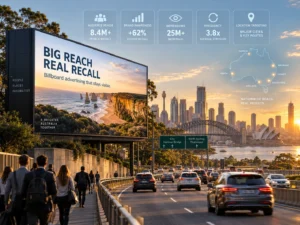
Billboard advertising can be highly effective in Australia when the campaign combines the right audience, location, frequency, creative, and measurement.
A billboard has only a short viewing window to attract attention and communicate a message. Effectiveness therefore comes from more than placing a large advertisement beside a busy road.
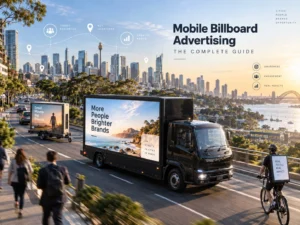
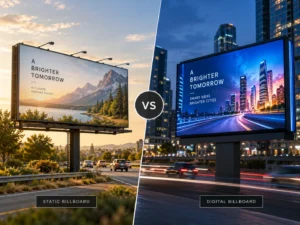
Static billboards create repeated visibility from one fixed position. Mobile billboards add movement, flexible routing and the ability to place a campaign across multiple audience locations.
Both formats can create strong awareness. The important question is whether the campaign reaches relevant people, creates enough repetition and produces measurable movement towards the campaign objective.
What Makes Billboard Advertising Effective?
Billboard effectiveness is the ability to influence a defined campaign outcome through visibility, relevant exposure and repetition.
That outcome changes according to the campaign.
A brand-awareness campaign can focus on reach, frequency and branded search activity. A retail campaign can examine store visits, website activity or promotion engagement. An event campaign can measure landing-page visits, ticket activity and attendance.
Lead-generation campaigns can track calls, enquiries and campaign-specific landing pages.
This distinction matters because visibility alone does not prove effectiveness.
A billboard can attract thousands of views while producing little commercial value when the location, audience or message does not match the campaign objective.
Why Do Billboards Get Attention?
Billboards create attention through physical scale, prominent placement and repeated presence within everyday environments.
Drivers, commuters, pedestrians and shoppers encounter outdoor advertising as they move through roads, retail areas, transport corridors, entertainment precincts and event zones.
Traditional static billboards maintain a fixed presence in one location.
Mobile billboard trucks add movement. The advertisement can appear in different suburbs, business districts, shopping areas and event environments throughout the campaign.
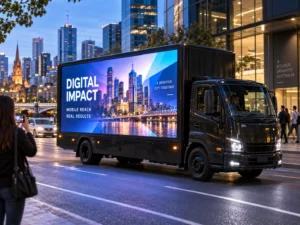
Digital mobile billboards add another visual element through bright LED screens and rotating creative.
However, attention represents only the first stage of effectiveness.
A person can notice a billboard without understanding what it advertises.
Creative still needs to communicate quickly through large typography, strong contrast, recognisable branding and one dominant idea.
Placement creates the opportunity to be noticed. Creative determines what the audience understands.
How Billboard Advertising Builds Reach
Billboard reach depends on the number and relevance of people who have an opportunity to encounter the campaign. Static billboard reach is strongly connected to the audience moving past its fixed position.
Mobile billboard reach changes according to:
- Route selection
- Audience density
- Operating times
- Campaign duration
- Geographic coverage
- Repeated passes
- Audience behaviour within each location
A campaign travelling through Sydney CBD, Melbourne commuter areas or Brisbane retail precincts encounters different audience groups during different periods of the day.
The largest possible audience is not automatically the most valuable audience.
A billboard seen by 10,000 people who have little connection with the product can provide less useful exposure than repeated visibility among a smaller group of relevant customers.
Effective reach means reaching the people who matter to the campaign, rather than collecting the largest possible exposure number.
Verified audience data strengthens this distinction by showing whether campaign exposure aligns with audience characteristics such as age, gender, and interests.
Reach and Repetition Work Together
Reach measures how broadly a campaign is exposed. Frequency measures how repeatedly the audience encounters it.
Both influence advertising effectiveness.
A static billboard positioned on a commuter route can repeatedly reach the same people as they travel through the area each day.
A mobile billboard can create repetition differently. The vehicle can return to priority suburbs, commuter corridors, retail precincts or event areas while also moving between several locations.
A local retailer can gain more value from repeated exposure around its trading area than from one brief appearance across an entire city.
A major product launch can place greater value on wider geographic exposure across several audience zones.
The right balance between reach and repetition depends on the campaign objective and the way the intended audience moves.
Why Location Has Such a Strong Effect on Results
Billboard location determines who can see the campaign, when they can see it and under what viewing conditions.
Strong location planning considers where the intended audience:
- Lives
- Works
- Shops
- Commutes
- Socialises
- Attends events
- Spends leisure time
Location quality also depends on factors such as viewing angle, dwell time, traffic direction, surrounding activity and repeat exposure.
A business district has a different audience at 8:30 am from the audience present later in the evening.
A retail precinct on Saturday afternoon creates different exposure conditions from the same location early on Monday morning.
Slow traffic, pedestrian areas and event environments can provide longer viewing opportunities than fast roads.
For mobile advertising, distance travelled is therefore a weak measure of route quality by itself.
A stronger route puts the billboard where relevant audiences are present at the times they are present.
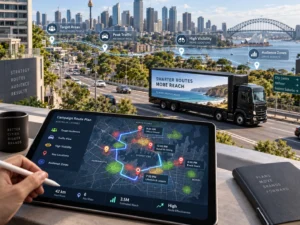
Heatmap-led planning adds another layer by identifying stronger-performing campaign locations and concentrating activity where the highest audience opportunity exists.
How Movement Changes Mobile Billboard Effectiveness
Movement gives mobile billboards an important advantage over fixed placement: the campaign can follow audience geography rather than depend on one location.
A truck can move between commuter corridors in the morning, commercial precincts during the day and entertainment areas later in the campaign schedule.
Movement can also support tactical activity around:
- Store openings
- Product launches
- Sporting events
- Festivals
- Conferences
- Shopping precincts
- Local business catchments
Mobility does not make every route effective.
A truck travelling continuously across an entire city can create broad exposure while producing limited repetition.
A more concentrated route can create multiple opportunities for the same audience to recognise the campaign.
The strongest route is therefore not necessarily the longest one.
Mobile billboard effectiveness depends on purposeful movement, not movement for its own sake.
How Creative Quality Affects Billboard Performance
Billboard creative needs to communicate before the viewing opportunity disappears.
Strong billboard creative concentrates attention around a small number of visual elements:
- One dominant message
- Short copy
- Large typography
- Strong visual contrast
- Recognisable branding
- One clear action
Complex creative increases the amount of information the audience needs to process.
Digital billboard trucks can rotate different artwork and campaign messages, but screen capability does not remove the need for simplicity.
Several concise creatives can support product variations, different offers or sequential messaging. Excessive animation, long sentences and crowded layouts reduce comprehension.
A billboard can therefore achieve high physical visibility while delivering weak communication.
Attention becomes valuable when the audience can quickly identify the brand, understand the message and remember what matters.
How Campaign Timing Affects Results
Campaign timing determines which audiences are present during exposure.
Morning campaigns can concentrate around commuter corridors. Midday activity can reach commercial districts, shopping precincts and business areas. Evening campaigns can align with hospitality precincts, entertainment areas and events.
Campaign duration influences frequency as well.
A short, concentrated campaign can suit an event, product launch or store opening.
A longer campaign can build familiarity through repeated exposure across multiple days or audience routines.
There is no universal campaign duration that guarantees effectiveness.
The appropriate schedule comes from the campaign objective, audience movement, and required exposure frequency.
Audience and location intelligence can make these decisions more precise by identifying where relevant people are concentrated and which locations create stronger campaign opportunities.
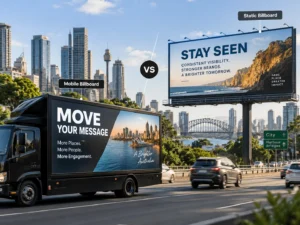
Static vs Mobile Billboards: How Does Effectiveness Differ?
Static and mobile billboards create effectiveness in different ways.
| Attribute | Static Billboard | Mobile Billboard |
| Location | One fixed site | Multiple planned locations |
| Repetition | Repeated traffic past the same site | Repeated passes across selected routes |
| Geographic flexibility | Fixed | Route can change |
| Audience strategy | Depends heavily on site audience | Route can follow target-audience movement |
| Campaign verification | Requires supporting measurement | GPS and route data can verify movement |
| Creative flexibility | Depends on format | Digital trucks can rotate creative |
| Event targeting | Limited to nearby sites | Can operate around relevant event zones |
Static billboards can build strong familiarity where the site sits within a valuable audience corridor.
Mobile billboards can extend geographic targeting by moving between different priority zones.
The better format therefore depends on the campaign rather than a universal winner.
A broader comparison of the formats is covered in Mobile Marketing Australia’s guide to why mobile digital billboard truck advertising differs from traditional billboards.
What Can Reduce Billboard Advertising Effectiveness?
Three campaign weaknesses can reduce performance even when the billboard itself is highly visible.
Poor Audience and Location Alignment
High traffic volume does not guarantee relevant exposure.
Campaign placement produces more value when the people associated with the location align with the intended audience.
Audience characteristics, traffic patterns, time of day and local behaviour therefore need to influence location planning.
Weak or Overloaded Creative
Billboards provide limited time for message processing.
Long headlines, multiple calls to action, weak contrast and competing visual elements make the message harder to understand. Simpler creative gives the brand and main proposition more room to register.
Measurement That Stops at Visibility
A campaign report becomes less useful when it only confirms that an advertisement existed.
Modern billboard evaluation can connect delivery evidence, audience data, and response activity to provide a stronger picture of performance.
How Do You Measure Billboard Advertising Effectiveness?
Billboard measurement works best when campaign delivery, audience quality and campaign response are evaluated separately and then connected.
1. Verify Campaign Delivery
Delivery measurement establishes whether the campaign operated as planned.
Mobile billboard reporting can include:
- GPS-tracked movement
- Route heat maps
- Campaign photography
- Reach and frequency data
Mobile Marketing Australia campaigns also provide 20+ high-resolution campaign photographs per day as evidence of on-street activity.
GPS data answers where the campaign travelled. Heat maps show how campaign activity was distributed. Photography provides visual proof of execution.
Together, these measures establish the physical delivery of the campaign.
2. Analyse Verified Audience Insights
Exposure becomes more meaningful when advertisers can understand who was associated with it.
Through Mobile Marketing Australia’s partnership with LUMOS Intelligence, campaigns can incorporate verified audience insights covering:
- Age
- Gender
- Interests
These audience attributes help compare campaign exposure with the intended customer profile.
A campaign designed to reach a particular demographic can therefore be evaluated using more than location data alone.
3. Measure Reach and Frequency
Reach indicates the breadth of campaign exposure. Frequency indicates repeated exposure. These metrics need to be interpreted against campaign strategy.
A broad awareness campaign can prioritise reach across several areas. A local campaign can prioritise repeated visibility within a smaller catchment.
Neither metric provides the complete answer independently.
4. Track Direct Response
Campaign-specific mechanisms can connect billboard exposure with measurable actions.
Examples include:
- QR-code scans
- Custom URLs
- Landing-page visits
- Phone calls
- Enquiries
- Promotion redemptions
- Website traffic
- Branded searches
QR codes and URLs record direct digital actions, although they do not capture every person influenced by the billboard.
5. Compare Business Activity
Business performance can be compared before, during and after the campaign.
Relevant measurements include store visits, enquiries, sales activity, event registrations or attendance.
A baseline strengthens the comparison.
For example, branded searches or store traffic recorded before the campaign can be compared with activity during the campaign period.
Changes can then be examined alongside route delivery, timing and audience data rather than being interpreted in isolation.
6. Extend the Campaign Through Audience Activation
Modern mobile billboard campaigns can continue beyond the physical exposure itself.
LUMOS Intelligence enables relevant audiences to be retargeted across 2,000+ publishers.
Audience IDs can also be passed back into an advertiser’s internal ecosystem through ID pass-back for further activation.
This creates a relationship between outdoor exposure and subsequent digital activity.
The billboard creates physical visibility. Audience intelligence can then support continued campaign communication across digital environments.
A Practical Billboard Measurement Framework
Campaign metrics become more useful when they correspond directly with the original objective.
| Campaign Objective | Useful Measures |
| Brand awareness | Reach, frequency, branded search |
| Local awareness | Repetition, direct traffic, branded search |
| Retail activity | Foot traffic, store visits, promotion engagement |
| Product launch | Reach, website activity, branded search |
| Event promotion | Landing-page visits, registrations, attendance |
| Lead generation | Calls, forms, enquiries |
| Route optimisation | Heat maps, audience insights, location performance |
| Audience activation | Retargeting, ID pass-back activity |
The campaign objective determines which numbers matter.
A reach figure means little for a lead-generation campaign when calls and enquiries are the intended outcome.
Likewise, immediate conversions do not tell the complete story for a broad brand-awareness campaign designed to build familiarity.
Why Mobile Billboards Are Easier to Verify
Mobile billboards create additional physical delivery data because the vehicle’s movement can be recorded.
Digital Mobile Billboards from Mobile Marketing Australia use GPS-tracked movement, route heat maps and campaign photography alongside audience intelligence.
The digital trucks provide 20m² of P4 LED display across three sides, allowing multiple creatives to rotate during a campaign.
Through LUMOS Intelligence, campaigns can also use verified age, gender and interest insights, heatmap-led planning and additional audience activation.
Heatmap-led planning helps concentrate campaign activity around the locations displaying stronger audience opportunity.
Retargeting across 2,000+ publishers and ID pass-back can then connect physical campaign exposure with subsequent digital activity.
This combination makes mobile billboard effectiveness easier to examine across 3 connected layers:
- Where the campaign ran
- Who the campaign reached
- What happened after exposure
The relationship between digital displays, audience data and physical environments is also central to understanding what DOOH billboard advertising is and how it works.
So, How Effective Is Billboard Advertising in Australia?
Billboard advertising can be highly effective when audience relevance, location, attention, repetition, timing, creative and measurement work together.
Static billboards create persistent visibility from strategically selected fixed locations.
Mobile billboards add movement, flexible geographic targeting and route-level campaign verification.
Digital mobile billboards add rotating creative, audience intelligence and stronger connections between physical exposure and digital activation.
No single factor determines performance.
High traffic cannot rescue irrelevant placement. Movement cannot rescue poor routing. Large screens cannot rescue cluttered creative. Exposure figures cannot replace a defined objective.
Effective campaigns connect the complete sequence:
Objective > Audience > Location > Exposure > Repetition > Response > Measurement
That sequence provides a stronger way to judge billboard advertising than visibility alone.
Frequently Asked Questions
Do Billboards Actually Work?
Billboards work when relevant audiences receive clear, repeated exposure in locations connected with the campaign objective. Performance depends on placement, creative quality, frequency, audience relevance, and measurement.
Are Mobile Billboards More Effective Than Static Billboards?
Neither format is universally more effective. Static billboards create repeated exposure from a fixed location. Mobile billboards can move between priority locations, follow audience activity, and produce route-level delivery data. The campaign objective determines which approach is more appropriate.
How Many People Can a Billboard Reach?
Billboard reach changes according to location, audience density, traffic, operating period, campaign duration and exposure opportunity. One universal impression figure cannot accurately describe every campaign.
How Important Is Repetition?
Repetition builds familiarity by giving audiences multiple opportunities to recognise and remember the campaign. Frequency can come from repeated traffic past a fixed billboard or repeated mobile billboard activity across priority locations.
Does Billboard Location Affect Results?
Location is one of the strongest performance variables in billboard advertising. Audience profile, travel direction, dwell time, traffic behaviour, local activity and campaign timing all affect the value of a location.
Can Mobile Billboards Measure Who They Reach?
Mobile billboard campaigns can combine physical delivery data with verified audience insights. Through LUMOS Intelligence, Mobile Marketing Australia campaigns can access verified age, gender and interest insights alongside route and heatmap information.
Can Billboard Audiences Be Retargeted Online?
Yes. Mobile Marketing Australia’s LUMOS Intelligence partnership enables relevant audiences to be retargeted across 2,000+ publishers or connected to an advertiser’s internal ecosystem through ID pass-back.
Turn Billboard Visibility Into Measurable Campaign Activity
A strong billboard campaign starts with knowing exactly who the campaign needs to reach and where that audience spends time.
Mobile Marketing Australia combines mobile billboard movement with GPS tracking, campaign photography, route heat maps, verified audience intelligence and data-led location planning across Australian markets.
Campaign audiences can also move from physical exposure into digital activation through LUMOS Intelligence retargeting and ID pass-back.
Explore Digital Mobile Billboards and let’s get your brand moving.