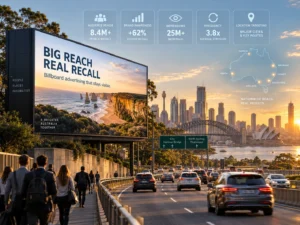
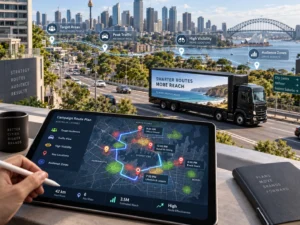
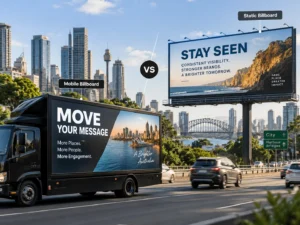
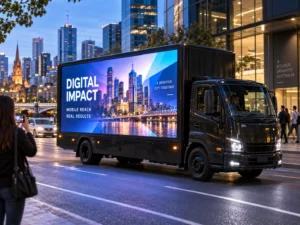
A good mobile billboard route is not simply the busiest road available. Effective mobile billboard route planning puts the campaign in front of the right audience, at the right time, in locations where the message has a genuine opportunity to register.
The strongest mobile billboard routes in Australia combine campaign objectives, audience movement, location relevance, campaign timing, repetition and measurement.
A truck travelling farther does not automatically produce a stronger campaign. In many cases, repeatedly covering a smaller group of relevant locations can be more useful than driving across an entire city.
This guide explains how to plan a mobile billboard campaign route around how people actually move through Australian cities and local markets.
Why Mobile Billboard Route Planning Matters
Mobility creates the opportunity to take advertising to different audiences, but the route determines how effectively that opportunity is used.
Strong mobile billboard campaign planning in Australia balances five considerations, which are:
- Campaign Objective
- Audience Relevance
- Geographic Coverage
- Exposure Frequency
- Operational Practicality
The best route rarely covers the most kilometres. It covers the locations that matter most to the campaign.
Modern route planning can also incorporate verified audience insights to understand whether selected locations align with the intended audience profile. Through Mobile Marketing Australia’s partnership with LUMOS Intelligence, campaigns can use verified audience insights covering age, gender and interests alongside location and movement data.
A local retailer can gain greater campaign relevance from repeated activity within its local catchment than from broad metropolitan travel. An event campaign can prioritise routes leading towards relevant event venues, while a B2B campaign can concentrate on commercial districts during weekday activity.
Route strategy therefore begins with the outcome the campaign needs to influence.
Step 1: Define What the Route Needs to Achieve
Every mobile billboard route in Australia should have a clear purpose before locations are selected.
Different campaign objectives create different route requirements.
Brand Awareness
A broader mobile billboard route in Australia can expose the brand across several relevant districts and audience groups. Coverage becomes more important where the objective is widespread recognition.
Retail and Store Openings
Local retail campaigns can concentrate on nearby residential areas, transport routes and shopping precincts. Repeated exposure around the store’s catchment can strengthen local familiarity.
Events
Event promotion can focus on routes connecting transport areas, entertainment districts and relevant event venues before attendees arrive.
B2B Campaigns
Professional audiences can be approached through CBD areas, commercial centres and weekday commuter corridors.
Product Launches
Product launches can combine highly relevant audience locations with broader awareness routes during the launch period.
The campaign objective determines which locations deserve priority and how frequently they should be revisited.
Step 2: Map Where Your Audience Actually Moves
Effective route planning focuses on behaviour rather than demographics alone.
Understanding audience movement means identifying where prospective customers spend time throughout their normal routines.
Useful questions include:
- Where do they work?
- Where do they shop?
- Where do they travel each morning and afternoon?
- Which commercial areas do they visit?
- Which events or entertainment districts attract them?
- Do they primarily travel by car, public transport or on foot?
- At what times are they most concentrated in each area?
This approach turns a list of locations into a genuine mobile billboard location strategy.
A university-focused campaign might prioritise campus approaches, transport hubs and nearby entertainment areas. A professional service campaign can focus on CBDs and business districts during working hours. A suburban retailer can concentrate activity around neighbouring communities and retail destinations.
The objective is to identify places with meaningful audience concentration, not simply places with large populations.
Verified audience insights can add another layer by helping advertisers understand the audience characteristics associated with campaign exposure, including age, gender and interests. This allows route decisions to consider not only where people move, but whether those audiences match the campaign objective.
Step 3: Judge Traffic Quality, Not Just Traffic Volume
One of the most common route-planning mistakes is treating the road with the highest traffic count as automatically the strongest option.
High traffic only becomes useful when the people travelling through the area are relevant to the campaign and have a meaningful opportunity to notice the message.
Evaluate traffic patterns using several factors.
Audience Relevance
A road carrying fewer people from the campaign’s target market can be more relevant than a major road dominated by unrelated traffic.
Viewing Conditions
Vehicle speed, intersections, road layout, and visibility influence how long an advertisement may remain within view.
Pedestrian Exposure
Areas with meaningful pedestrian traffic can create additional viewing opportunities beyond motorists.
Vehicle Exposure
Routes with substantial vehicle traffic can support commuter-focused campaigns, particularly where congestion or intersections create longer viewing windows.
Sight Lines
Buildings, trees, road geometry and other vehicles can influence whether the advertising display is clearly visible.
Dwell
Slower movement, queues, intersections and busy pedestrian environments can create stronger dwell opportunities than roads where audiences move past rapidly.
The stronger concept is high-relevance traffic, not simply high traffic.
Heatmap-led planning supports this approach by identifying locations that generate stronger campaign opportunities, helping advertisers focus activity on areas where audience relevance and exposure potential are highest.
Step 4: Choose the Right Types of Locations
The best locations for mobile billboard advertising vary according to the audience and objective.
Commuter Corridors
Commuter corridors work well where the campaign targets predictable morning or afternoon travel patterns.
Repeated movement through the same transport routes can also contribute to familiarity over several campaign days.
Retail and Shopping Areas
Shopping precincts can suit consumer promotions, launches and store activity because the advertising appears near places where purchasing behaviour already occurs.
CBD and Commercial Districts
Business districts concentrate office workers, professionals and weekday visitors. These locations can support B2B, recruitment and professional-service campaigns.
Event Areas
Relevant event venues can create concentrated audience exposure around sporting fixtures, concerts, conferences, exhibitions and festivals.
Audience relevance matters more than event size alone.
Suburban Centres
Residential and suburban commercial areas can provide effective geographic targeting for businesses serving defined service areas or local communities.
No location category is automatically superior. The strongest choice is the one that brings the campaign closest to the intended audience.
Step 5: Match the Route to the Time of Day
A location can be valuable during one period and relatively weak during another.
Dayparting divides campaign activity according to different parts of the day so routes can follow changing audience behaviour.
Morning
Morning routes can focus on residential-to-commercial travel, transport hubs and key commuter corridors.
Midday
CBDs, office districts and retail areas can become more useful as people move between workplaces, shops and lunch destinations.
Afternoon
School-area movement where appropriate, suburban commercial centres and retail environments can experience greater activity.
Evening
Entertainment areas, hospitality districts and relevant event venues can become stronger locations.
Weekends
Retail centres, sporting destinations, entertainment areas and community events can replace weekday commuter patterns.
Effective campaign timing therefore considers both location and audience activity. The same route does not need to carry equal value throughout the entire day.
Audience insights and location performance data can further support daypart decisions by showing which periods and areas create stronger opportunities for reaching relevant audiences.
Step 6: Decide Between Broad Reach and Route Repetition
A key mobile billboard route decision is whether to cover more locations or revisit fewer high-value locations more frequently.
A broad route increases geographic coverage. It can introduce the campaign to audiences across several districts, suburbs or precincts.
A focused route prioritises route frequency. The truck repeatedly passes through a smaller group of strategically relevant areas, creating more opportunities for the same local audience to encounter the message.
Neither strategy is universally better.
A national brand launch can value broader exposure across several metropolitan zones. A new suburban retailer can benefit more from repeated visibility within a clearly defined local catchment.
Hybrid strategies can combine both approaches. Core locations can receive repeated exposure while selected campaign periods extend into secondary areas.
The best routes for mobile billboard advertising balance reach with repetition according to what the campaign needs to achieve.
Step 7: Plan Around Events and Audience Concentration
Events can create predictable periods of high audience concentration, but crowd size alone does not make an event valuable.
Audience fit comes first.
A sporting brand can find strong relevance around major fixtures. A B2B company can achieve stronger audience alignment at a conference than at a much larger entertainment event. A local hospitality business can benefit from nearby festivals or community events drawing people into its service area.
Route planning around event venues should consider:
- audience arrival periods;
- transport connections;
- surrounding commercial areas;
- post-event movement;
- access restrictions;
- road and parking conditions.
The campaign needs to appear around relevant audience movement rather than simply approaching the largest available crowd.
Step 8: Check Operational and Local Constraints
A commercially strong route also needs to be operationally practical.
Campaign planning should account for:
- road access;
- vehicle restrictions;
- parking requirements;
- traffic rules;
- local advertising requirements;
- event-specific restrictions;
- practical travel time between target areas.
A route that looks efficient on a map can become inefficient when congestion, access limitations or unrealistic travel times are considered.
Operational planning therefore forms part of mobile advertising route planning rather than being treated as an afterthought.
Step 9: Use GPS and Route Data Properly
GPS tracking provides a factual record of where a mobile billboard travelled during a campaign.
Route data can show:
- completed movement;
- time spent within target areas;
- operating periods;
- repeated passes;
- differences between planned and completed routes.
This makes route verification an important accountability tool.
However, GPS information answers one specific question: did the truck travel through the planned locations?
It does not automatically establish whether the route generated attention, enquiries or other campaign outcomes. Additional audience intelligence and location-performance data can help explain why certain routes perform differently, creating a stronger basis for future campaign planning.
A strong measurement approach therefore separates route verification from actual route performance.
Step 10: Measure Which Routes Actually Perform
Route performance requires more than confirming that the truck travelled through the planned areas.
Three layers can be examined.
Route Delivery
GPS tracking, photography and operating records confirm whether the activity occurred as planned.
Exposure Quality
Exposure analysis can consider audience concentration, pedestrian traffic, vehicle traffic, location context and available dwell opportunities.
Exposure analysis can consider audience concentration, pedestrian traffic, vehicle traffic, location context and available dwell opportunities. Heatmap-led planning and verified audience insights can provide additional context around which locations create stronger campaign opportunities.
Campaign Response
Advertisers can use signals such as:
- Campaign QR-code activity
- Dedicated landing-page visits
- Promo-code use
- Tracked calls
- Website traffic
- Branded search
- Enquiries
- Store visits
- And event attendance.
Campaign activity can also continue beyond the outdoor exposure itself. Through LUMOS Intelligence, relevant audiences can be retargeted across 2,000+ publishers, while ID pass-back can connect audience data with the advertiser’s internal ecosystem for further activation.
Comparing different route areas can reveal useful patterns where sufficient data is available.
For example, two campaign zones operating during comparable periods may generate different landing-page activity or store response. That does not create perfect attribution, but it can provide information for later route decisions.
Strong route measurement asks whether the truck went to the right places, rather than simply whether it travelled the planned distance.
Common Mobile Billboard Route Planning Mistakes
Several decisions can weaken mobile billboard advertising routes.
Choosing Only the Busiest Roads
Large traffic counts do not compensate for weak audience relevance.
Covering Too Much Geography
Trying to visit every possible location can reduce route frequency within the areas that matter most.
Ignoring Audience Routines
Routes built around locations rather than audience movement can miss the periods when those locations are valuable. Ignoring available audience insights can create the same problem by selecting locations that appear busy but do not align with the intended campaign audience.
Running the Same Route All Day
Ignoring dayparting can leave the campaign in areas after the target audience has moved elsewhere.
Treating Events as Automatically Valuable
Large event venues only become strategically relevant when attendees overlap with the intended audience.
Measuring Distance Instead of Outcomes
Kilometres travelled provide little information about whether the campaign reached relevant people or influenced the intended result.
Example: How to Choose a Mobile Billboard Route for a Store Opening
Consider a retailer opening a new location within a suburban shopping district.
The campaign objective is opening-week awareness among residents within the surrounding local catchment.
Morning activity can focus on commuter corridors connecting nearby suburbs with employment areas.
Midday activity can move towards the store’s shopping precincts, where customer relevance and pedestrian traffic increase.
Afternoon routes can cover local commercial areas and major access roads serving nearby residential suburbs.
Weekend activity can focus more heavily on retail and leisure destinations.
The campaign can prioritise route frequency within the primary catchment rather than attempting to cover the entire metropolitan area.
GPS tracking and route verification confirm campaign delivery, while store traffic, website activity, branded search and campaign-specific engagement provide additional indications of response.
GPS tracking and route verification confirm campaign delivery, while audience insights, store traffic, website activity, branded search and campaign-specific engagement provide additional indications of campaign performance.
This approach illustrates how to plan a mobile billboard campaign route around customer behaviour rather than distance alone.
Frequently Asked Questions
What Makes a Good Mobile Billboard Route?
A strong route combines audience relevance, appropriate campaign timing, useful viewing conditions and sufficient route frequency to support the campaign objective.
Should Mobile Billboard Trucks Always Use Busy Roads?
No. High traffic can help, but audience relevance, traffic patterns, viewing conditions and dwell opportunities also determine route quality.
What Time of Day Is Best for Mobile Billboard Advertising?
The best time depends on audience routines. Dayparting can align route activity with commuter, retail, commercial, entertainment or event audiences at different periods.
How Often Should a Mobile Billboard Repeat the Same Route?
There is no universal frequency. Repetition depends on campaign objectives, geographic reach, audience behaviour and the importance of specific locations.
Are Events Good Locations for Mobile Billboard Campaigns?
Events can be valuable where attendees match the target market. Audience relevance should be assessed before crowd size.
How Does GPS Help With Mobile Billboard Routes?
GPS tracking records campaign movement and supports route verification, allowing planned activity to be compared with completed routes and operating periods. Additional audience and location data can help explain which route decisions create stronger campaign opportunities.
Can Mobile Billboard Routes Change During a Campaign?
Routes can potentially be adjusted where operational conditions, campaign requirements, and local constraints allow. Performance information and changing traffic patterns can help inform those decisions.
How Can Audience Data Improve Mobile Billboard Route Planning?
Audience data can help advertisers understand whether selected routes align with the intended campaign audience. Through Mobile Marketing Australia’s partnership with LUMOS Intelligence, campaigns can use verified age, gender, and interest insights alongside location and movement data.
Build the Route Around the Audience
Strong route strategy in Australia starts with the campaign objective, follows real audience movement, accounts for changing traffic patterns, and uses repetition where it adds value.
Mobile Marketing Australia plans mobile billboard routes around audience relevance, verified audience insights, campaign timing, geographic targeting and measurable delivery rather than simply maximising kilometres travelled.
Explore our mobile billboard advertising to plan a campaign around the places and moments that matter.