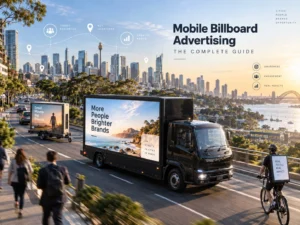
A mobile digital billboard truck is a purpose-built advertising vehicle fitted with high-brightness digital LED screens that display advertising while travelling through planned routes or operating around selected locations. The format combines digital out-of-home advertising with mobility, giving advertisers control over where the campaign appears, when it operates and which creative is displayed.
Australian campaigns can use digital billboard trucks around commuter routes, shopping precincts, CBDs, suburban centres, events and other high-traffic environments. The digital screens can also rotate multiple advertisements or update messaging during a campaign.
Understanding the format starts with four elements: the truck, LED display technology, campaign creative and planned location strategy.
What Is a Mobile Digital Billboard Truck?
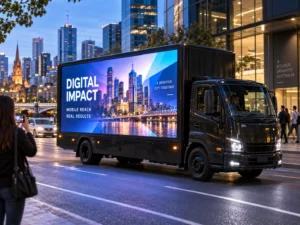
A mobile digital billboard truck combines a commercial vehicle with large electronic advertising screens designed specifically for outdoor media campaigns. The truck carries the advertisement through locations selected according to the campaign audience and objective.
Mobile Marketing Australia’s digital mobile billboard trucks provide 20m² of P4 LED screen space across three sides of the vehicle, creating visibility from multiple viewing angles. Digital artwork can rotate throughout the campaign, while campaign movement is tracked using GPS.
A digital billboard truck differs from an ordinary branded commercial vehicle. Vehicle wraps turn an operational car, van, or truck into advertising space while the vehicle performs another primary function. A mobile billboard truck exists specifically to deliver an advertising campaign.
The complete format can be understood as:
| Element | Role |
| Vehicle | Moves the campaign between selected locations |
| LED screens | Display digital advertising |
| Creative | Communicates the campaign message |
| Route and schedule | Determine where and when audiences see it |
| Tracking | Records campaign delivery |
The broader category of mobile billboard advertising also includes static trucks, trailers, bikes, and pedestrian-level formats.
What Makes a Mobile Billboard Truck Digital?
Electronic LED screens make a mobile billboard truck digital because advertisements are displayed as digital files rather than permanently printed artwork.
Digital capability changes what advertisers can do during the campaign. One truck can display multiple creatives, rotate promotional messages, and update artwork without replacing printed vinyl.
Digital mobile billboard content can include:
- static digital artwork;
- animated graphics;
- multiple campaign messages;
- promotional offers;
- event information;
- countdown messaging;
- time-based creative;
- short motion content where suitable.
A retailer could promote breakfast messaging in the morning, a lunchtime offer during the middle of the day and an evening promotion later in the campaign. A product launch could rotate between brand creative, product imagery and a launch date.
Digital flexibility increases creative options, but outdoor advertising still needs immediate comprehension. More screen capability does not mean more information should be placed into each advertisement. Large typography, one main idea, strong visual contrast and clear branding remain essential because audiences can have only a short viewing window.
Mobile Billboard Truck vs Digital Billboard Truck vs LED Billboard Truck
Mobile billboard truck is the broad category, while digital billboard truck and LED billboard truck describe trucks that use electronic display technology.
Advertising terminology overlaps because multiple names can describe closely related formats.
| Term | Meaning |
| Mobile billboard truck | Broad term for a truck carrying advertising |
| Digital billboard truck | Advertising truck using electronic screens |
| LED billboard truck | Digital truck using LED display technology |
| Static mobile billboard | Truck or trailer using printed advertising |
| Digital billboard | Electronic advertising screen, commonly fixed in one location |
A mobile billboard can therefore be either static or digital. A mobile LED billboard truck is a digital version of the broader mobile billboard format.
A fixed digital billboard uses similar electronic display principles but remains attached to one site. The mobile format adds route planning and campaign scheduling to the media strategy.
How Does a Digital Billboard Truck Work?
A digital billboard truck campaign moves through six stages: objective, audience, route, schedule, creative, and reporting.
1. Define the Campaign Objective
Campaign planning starts with the result the advertiser wants to influence. Objectives can include brand awareness, retail traffic, event attendance, product-launch visibility or a local promotion.
2. Identify the Audience and Locations
Audience behaviour determines where the campaign should operate. Relevant locations can include commuting corridors, retail precincts, business districts, entertainment areas, suburban centres and event venues. Through Mobile Marketing Australia’s partnership with LUMOS Intelligence, campaign planning can also use verified audience insights covering age, gender and interests to better understand the audience profile associated with campaign locations.
3. Plan the Route and Schedule
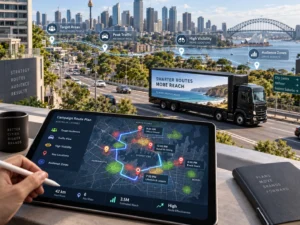
Route planning combines place, time and audience opportunity. A business audience can be concentrated around commercial areas during working hours, while an event campaign can concentrate activity around a venue before attendees arrive. Heatmap-led planning can help identify stronger-performing locations and focus campaign activity around areas with higher audience relevance.
4. Prepare the Digital Creative
Creative files are produced to suit the display dimensions and outdoor viewing environment. Multiple advertisements can be prepared where message rotation forms part of the campaign.
5. Deploy the Truck
The mobile advertising truck follows the planned campaign route and operating schedule. Route priorities can change across different periods of the day according to the audience strategy.
6. Track Delivery and Response
GPS movement, campaign photography, and reporting verify campaign delivery. Response mechanisms can then help evaluate what happened after audiences saw the advertising.
Does a Digital Billboard Truck Stay Moving All Day?
A digital billboard truck can combine planned driving routes, repeated passes and strategically selected stationary exposure where local conditions and applicable requirements permit.
Constant movement is not the objective by itself. The stronger objective is placing the advertising where the intended audience has a meaningful opportunity to see it.
A campaign can travel through commuter corridors before moving towards shopping precincts later in the day. Event activity can concentrate around roads and locations connected with attendee movement. Repeated passes through an important catchment can also build campaign frequency.
Route planning therefore considers audience, location, timing and repetition together rather than measuring success by kilometres travelled. Heatmap insights can further support route decisions by showing which locations create stronger campaign opportunities.
What Can You Display on a Mobile Digital Billboard Truck?
A mobile digital billboard truck can display digital artwork, rotating advertisements, animated graphics, promotional messaging and other screen-based creative suited to outdoor viewing.
Digital campaigns can use multiple pieces of creative within one campaign. Examples include different products, promotional offers, event messages and campaign stages.
Digital capability also enables contextual scheduling. A restaurant campaign could run breakfast, lunch and dinner creative at different times. An event promoter could move from ticket messaging before an event to directional or awareness creative closer to the venue.
Creative Still Needs to Work at a Glance
Effective mobile billboard creative follows five practical principles:
- Communicate one main idea. Every creative needs a clear primary message.
- Use large typography. Important wording needs to remain readable from a distance.
- Prioritise the brand. Logo and brand identifiers need obvious visual placement.
- Create strong contrast. Foreground elements need clear separation from the background.
- Keep the action simple. URLs, event dates, store locations or short calls to action work better than complicated instructions.
QR codes can support campaigns aimed at pedestrians or stationary audiences. Safe engagement comes first, so creative should never encourage motorists to scan a code while driving.
Where Are Mobile Digital Billboard Trucks Used?
Mobile digital billboard trucks work best where advertisers can identify meaningful places and times to reach an audience.
Retail Precincts
Retailers can concentrate campaigns around shopping centres, high streets and local catchments for store openings, sales or seasonal promotions.
Events
Sports fixtures, exhibitions, festivals and entertainment events create defined audience movements that can inform campaign timing and routes.
Commercial Areas
Business districts can support campaigns targeting professionals, workers and weekday commuter audiences.
Local Campaigns
Specific suburbs and neighbouring areas can be incorporated into routes for geographically focused advertising.
Product Launches
Launch campaigns can create concentrated visibility across several locations during a defined promotional period.
Community Awareness
Public information and community campaigns can use route planning to reach selected geographic audiences.
Why Use a Digital Billboard Truck Instead of a Fixed Billboard?
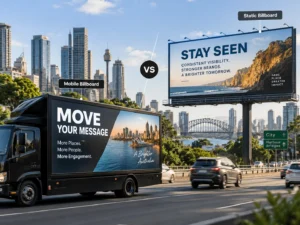
A digital billboard truck adds mobility, scheduling, and changeable creative to digital outdoor advertising. A fixed billboard provides continuing visibility from one location.
Digital mobile campaigns can also combine physical movement with audience and location intelligence, allowing advertisers to evaluate not only where a message appears but the audience context and campaign opportunities associated with those locations.
Four differences matter most.
1. Mobility
Mobile campaigns can operate across several locations instead of relying on people passing one advertising site.
2. Scheduling
Campaign activity can align with commuting periods, shopping times, events or other audience movements.
3. Digital Creative
Electronic screens allow different creatives to run during the same campaign without producing replacement printed skins.
4. Campaign Concentration
Advertisers can concentrate exposure into a launch window, event period or promotional period rather than maintaining a long-term fixed-site presence.
Fixed digital billboards remain valuable where persistent visibility from one established location is the primary media objective. Mobile and fixed formats therefore solve different campaign problems.
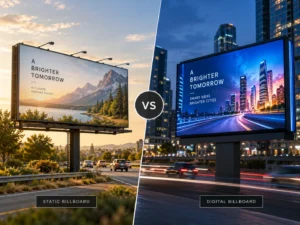
Digital Billboard Truck vs Static Mobile Billboard
The main difference between digital and static mobile billboards is how the advertising creative is displayed and changed.
| Feature | Digital Truck | Static Mobile Billboard |
| Display | LED screen | Printed vinyl |
| Multiple creatives | Yes | Primarily one |
| Animated content | Available | No |
| Creative changes | Digital update | New artwork required |
| Message flexibility | High | Fixed |
| Strong fit | Dynamic or time-sensitive campaigns | Simple, consistent campaigns |
A digital truck suits campaigns that benefit from multiple messages, changing promotions, or scheduled creative. A traditional mobile billboard suits campaigns built around one consistent message for the campaign period.
How Are Digital Billboard Truck Campaigns Tracked?
Digital billboard campaign tracking answers three separate questions: did the media run as planned, who was associated with campaign exposure, and what response activity followed the advertising? Separating these areas prevents delivery verification, audience intelligence and marketing performance from being treated as the same measurement.
Separating those questions prevents delivery verification from being mistaken for marketing performance.
Campaign Verification
Mobile Marketing Australia uses GPS-tracked movement and route heat maps to record campaign activity. Clients also receive 20+ high-resolution photographs each campaign day as proof of on-street delivery.
Post-campaign reporting can include full tracking information, third-party verified reach and frequency data, and audience insights that provide additional context around campaign exposure.
Through LUMOS Intelligence, campaigns can also use verified audience insights covering age, gender and interests. This helps advertisers understand the audience profile associated with campaign exposure alongside physical campaign delivery.
These records establish where the campaign operated and how the planned media activity was delivered.
Campaign Response
Marketing performance requires additional response signals connected with the campaign objective.
Relevant measurements can include:
- QR-code Scans;
- Campaign Landing-Page Visits;
- Tracked Phone Calls;
- Campaign-Code Use;
- Website Traffic;
- Branded Searches;
- Enquiries;
- Bookings;
- Store Visits;
- Event Attendance.
A retailer seeking foot traffic needs different performance indicators from a brand running an awareness campaign. Campaign measurement becomes more useful when KPIs are selected before the truck goes on the road.
Baseline data also creates context. Comparing branded search, website sessions, enquiries or physical visits before, during and after campaign activity helps advertisers interpret changes more effectively.
Campaign audiences can also continue beyond the physical billboard exposure. Through LUMOS Intelligence, audiences can be retargeted across 2,000+ publishers, or relevant IDs can be passed back into the advertiser’s internal ecosystem for further activation.
When Should You Choose a Mobile Digital Billboard Truck?
A digital billboard truck is a strong choice when geography, timing, physical visibility and flexible creative all matter to the campaign.
The format fits campaigns where:
- audiences gather in identifiable locations;
- specific suburbs or precincts matter;
- event timing influences exposure;
- multiple messages need to rotate;
- a launch requires concentrated visibility;
- creative needs to change during the campaign;
- physical presence supports broader digital activity.
Other advertising formats deserve greater consideration where permanent visibility from one site is the primary objective or where the audience can only be defined through highly precise individual targeting.
The useful question is therefore not whether digital billboard trucks are universally effective. The useful question is whether mobility, digital creative and location strategy match the campaign objective.
Mobile Digital Billboard Trucks in Australia
Australian mobile digital billboard campaigns can be planned across metropolitan centres, suburban commercial areas, local catchments, retail precincts and event environments.
Sydney, Melbourne and Brisbane provide combinations of CBD traffic, shopping areas, commuter corridors and major event destinations, while regional and suburban campaigns can concentrate activity within smaller geographic markets.
Campaign operation also needs to account for applicable road, parking and local advertising requirements relevant to the locations involved.
Mobile Marketing Australia operates digital mobile billboards as part of a wider Australian outdoor media fleet and offsets every booked campaign through its Greenfleet partnership.
Frequently Asked Questions
What Is a Mobile Digital Billboard Truck?
A mobile digital billboard truck is an advertising vehicle fitted with electronic LED screens that display campaign creative while travelling through planned routes or operating around selected locations.
How Does a Digital Billboard Truck Work?
A digital billboard truck follows a planned campaign combining audience targeting, route selection, operating times, digital creative, and reporting. The truck displays the advertising while moving through locations relevant to the campaign.
Is a Digital Billboard Truck the Same as an LED Billboard Truck?
Digital billboard truck and LED billboard truck are commonly used to describe the same type of advertising vehicle. LED refers to the display technology, while digital refers more broadly to the electronic advertising format.
Can Digital Billboard Trucks Display Video?
Digital billboard trucks can support motion-based creative where the screen system and campaign setup allow it. Outdoor video still needs simple visual communication because audiences can have short viewing periods.
Can Mobile Billboard Trucks Target Specific Suburbs?
Campaign routes can be planned around individual suburbs, local catchments and selected precincts. Campaign schedules can then align activity with the times relevant audiences are present.
Are Digital Billboard Trucks Visible During Daylight?
High-brightness outdoor LED technology is designed for visibility in daytime outdoor environments. Actual visibility also depends on screen specifications, creative contrast, viewing distance, and environmental conditions.
How Are Digital Billboard Truck Campaigns Tracked?
GPS data, route heat maps, campaign photography, and verified reach and frequency reporting can document campaign delivery. Campaigns can also use verified audience insights covering age, gender and interests, alongside response measures such as QR codes, landing pages, calls, searches, enquiries or store activity.
Can Mobile Digital Billboard Trucks Provide Audience Insights?
Mobile digital billboard campaigns can combine physical delivery data with verified audience insights. Through Mobile Marketing Australia’s partnership with LUMOS Intelligence, campaigns can access verified age, gender and interest insights to better understand the audience associated with campaign exposure.
What Is the Difference Between a Mobile Billboard Truck and a Fixed Digital Billboard?
A mobile billboard truck carries digital advertising between planned locations, while a fixed digital billboard remains at one permanent advertising site. Mobility adds route and scheduling flexibility to the campaign.
Take Digital Outdoor Advertising to the Audience
A mobile digital billboard truck gives a campaign more than a large screen. Route planning determines where the message appears, scheduling determines when audiences encounter it, and digital technology determines how the creative can change throughout the campaign.
Mobile Marketing Australia operates 20m² three-sided P4 LED digital mobile billboards with GPS tracking, campaign photography, verified reporting and audience intelligence across Australian markets.
Through LUMOS Intelligence, campaigns can use audience insights and location data to support smarter planning, measurement and activation.
Explore Digital Mobile Billboards and let’s get your brand moving.