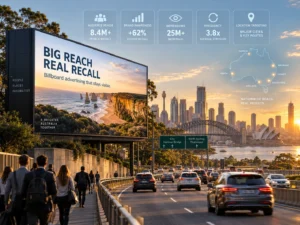
Ask 10 marketers whether static or digital billboards perform better, and you’ll get 10 different answers.
That’s because the real answer depends on what your campaign needs to achieve. Not on which format sounds more modern.
What’s the Difference Between Static and Digital Billboards?
One core difference splits these two formats.
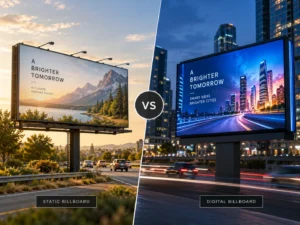
A static billboard shows one printed image for the whole booking. A digital billboard rotates multiple images on an illuminated LED screen.
Did you know? Australia’s out-of-home (OOH) advertising industry has expanded significantly, with digital formats taking a larger share of outdoor advertising activity in recent years. Digital formats have expanded across Australia’s OOH landscape, increasing the range of creative and scheduling options available to advertisers.
LED billboards now show up across city centres, transport hubs, and major roads. But neither format wins by default. Each is a different tool built for a different job, and the right pick depends on your goal, audience, location, campaign duration, and creative requirements.
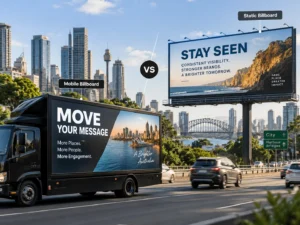
Static vs Digital Billboard Comparison
5 factors set these two formats apart: visibility, location, frequency, flexibility, and audience impact. Let’s take a closer look at them.
| Feature | Static Billboard | Digital Billboard |
| Visibility | Visible by day; lighting or reflective material boosts night visibility | Illuminated 24/7; brightness adjusts to ambient light |
| Location Availability | Wider availability, including highways and regional areas | Concentrated in city centres and commercial districts |
| Frequency | Displayed continuously, same image at all times | Rotates in timed cycles of 6 to 15 seconds |
| Flexibility | Booked for longer periods; visual changes require reprinting and physical installation | Bookable weekly; visuals swapped anytime |
| Audience Impact | Relies on location-based exposure and repeated visibility | Supports flexible messaging, time-based scheduling, and audience-informed campaign planning |
| Best For | Long-term brand recognition and recall | Short-term, message-testing, and CTA-driven campaigns |
Modern billboard campaigns can also be evaluated beyond physical visibility. Through Mobile Marketing Australia’s partnership with LUMOS Intelligence, campaigns can use verified audience insights covering age, gender, and interests to better understand the audience associated with campaign exposure.
Visibility: Which One Gets Seen More?
Well, it depends on the time of day.
Static billboards stay clearly visible in daylight, and lighting or reflective skins give them a boost at dusk and at night. Digital billboards win on raw illumination since they stay lit around the clock.
But here’s the catch:
24/7 brightness matters less than it sounds if your campaign isn’t targeting a night-time audience. Viewing traffic still peaks during the same daylight and rush-hour windows for both formats.
Location Availability: Where Can You Actually Book One?
Static billboards currently have the edge here. Australia has more static sites than digital ones right now, though that gap is closing fast.
Static billboards dominate remote areas and major highways outside city limits. That gives businesses more placement options, and more say over exactly where their message shows up. Digital billboards cluster in busy city centres and commercial precincts.
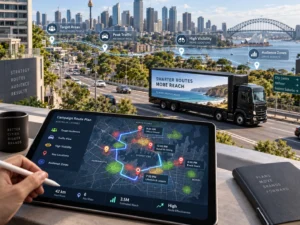
Location selection plays a major role in campaign effectiveness across both formats. Heatmap-led planning helps identify the locations generating stronger audience opportunities, allowing campaign decisions to focus on performance data rather than availability alone.
Frequency: How Often Does Your Ad Actually Show?
This is where the two formats split the most.
A static billboard shows the same image for the entire booking. A digital billboard rotates through a series of ads in 6- to 15-second cycles. Seeing the same message, in the same spot, for months builds strong brand recall. Repetition is what cements a brand in someone’s memory. Digital billboards share screen time with other advertisers during each rotation, so message consistency takes a small hit, but you can offset that by booking multiple slots to extend total viewing time.
Flexibility: Can You Change Your Message Mid-Campaign?
This is one of the biggest differences between the two formats.
Static billboards use one printed visual for the booking period, with any creative change requiring new artwork production and physical installation. Digital billboards allow creative to be updated during the campaign, making it possible to test different messages, respond to promotions, or adapt content by time of day.
Digital campaigns can also run across shorter campaign periods, giving advertisers greater control over when messages appear and how frequently creative changes.
Audience Impact: Which Format Fits Your Goal?
Ask yourself: are you building long-term brand recognition, or driving a campaign that requires flexible messaging and audience activation?
Static billboards create consistent visibility through one fixed message displayed over time, making them suitable for campaigns focused on repeated brand exposure. Digital billboards add creative flexibility through rotating messages, timed content changes, and audience-focused campaign planning. Verified audience insights covering age, gender and interests provide additional context for understanding who the campaign reaches and how closely that audience aligns with the campaign objective.
Are Digital Billboards Better Than Static Billboards?
Not automatically, even though that’s a common assumption.
Both formats serve different purposes. The strongest choice depends on the campaign objective, audience profile, location strategy, creative requirements, and measurement approach. Campaigns seeking broader outdoor exposure can combine static and digital formats rather than relying on one format alone. Combining static and digital in the same campaign can extend reach while supporting both long-term visibility and flexible messaging.
Static vs Digital: A Simple Way to Decide
Think of it like this.
A static billboard is a poster on a wall. It stays the same until someone takes it down. A digital billboard is a TV screen. It keeps changing what it shows.
Choose static if the goal is planting one memorable image in people’s heads over a long stretch of time.
Choose digital if the goal is testing a few messages, reacting quickly to a promotion, or reaching a busy city audience during specific hours.
| Digital Billboard | Rotation Cycle | 6-15 seconds per ad |
| Digital Billboard | Illumination | 24/7 |
| Static Billboard | Booking Length | Several months |
| Digital Billboard | Booking Length | Weekly intervals |
| Static Billboard | Location Advantage | Highways and regional areas |
| Digital Billboard | Location Advantage | City centres and commercial districts |
| Static Billboard | Primary Strength | Long-term recall |
| Digital Billboard | Primary Strength | Message testing and CTA response |
Why Choosing One Format Doesn’t Have to Be the End of the Decision
Here’s the good news: you don’t have to pick a side.
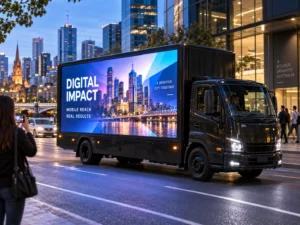
Mobile billboards remove the static-vs-digital trade-off entirely, because both options run on the same vehicle. Traditional Mobile Billboards give you the same single, consistent-message strength as a static site, but on a route that moves through exactly where your audience already is. Digital Mobile Billboards bring the rotating-visual flexibility of a digital screen to that same moving format, running 20m² of LED display across three sides of the truck, with the ability to swap creative throughout the campaign.
Mobile billboard campaigns can also extend beyond physical exposure. Through LUMOS Intelligence, campaign audiences can be retargeted across 2,000+ publishers, or relevant IDs can be passed back into an advertiser’s internal ecosystem for further activation. This connects outdoor exposure with broader digital campaign activity.
Still unsure which format fits? Compare both directly in our guide on why digital mobile billboard truck advertising is superior to traditional billboards to explore the differences in visibility, movement, creative flexibility, and campaign measurement.
Test Both Formats Before You Commit to One
Most businesses spend weeks debating static versus digital in a boardroom.
A better decision starts with the campaign objective, audience, location, duration, and creative requirements. Testing different formats and reviewing campaign data, audience insights, and location performance provides a clearer basis for deciding which approach deserves a larger role in future activity.
Effective billboard decisions come from understanding more than the physical format. Audience insights, location performance data, campaign delivery reporting and creative flexibility all contribute to a clearer picture of campaign effectiveness.
Let’s get your brand moving with Mobile Marketing Australia. Call 1300 234 448 and get a side-by-side recommendation built around your actual audience before you lock in a single format.