Choosing the wrong outdoor advertising partner can turn a promising campaign into an underperforming one. Choosing the right partner gives the campaign stronger targeting, clearer measurement, and better control over how the message reaches its audience.
A mobile billboard advertising company proves its value through verified audience data, multiple format options, and results that can be measured rather than estimated. Nine factors separate a genuine outdoor advertising partner from an inventory reseller: brief-led discovery, verified measurement, fleet diversity, route strategy, carbon accountability, campaign transparency, contract clarity, referenceable case studies, and direct access to a decision-maker.
This guide walks through each one, so you’ve got a working filter before you sign anything.
Determine Whether the Company Solves Your Brief or Just Sells Inventory
Here’s a simple test: count how many minutes the first call spends on your audience, launch dates, and success metrics, versus how many minutes it spends pitching available trucks or panels. That ratio tells you almost everything. Use this 4-step filter to separate a consulting partner from an inventory reseller.
Step 1: Identify the Inventory-Led Default
Most outdoor advertising operators in Australia are inventory-led, meaning the conversation starts with what’s on the fleet rather than what the campaign needs. Recognising this default is the first step before you evaluate any vendor’s approach.
Step 2: Test Whether the Approach Fits Your Brief
An inventory-led pitch works fine when the available fleet happens to match the campaign, and falls short when it doesn’t. If your brief is flexible, you’ve got less to lose from this approach than a business with a specific audience or route requirement.
Step 3: Listen for Consulting Signals vs Selling Signals
Pay attention to how the first call unfolds. A partner who asks about your target audience, campaign dates, and geographic priorities before recommending a format is consulting. A partner who opens by pushing available inventory before understanding the campaign is selling.
Step 4: Confirm the Brief Drives the Recommendation
The brief should drive the recommendation, not the other way around. Mobile Marketing Australia starts every enquiry with the audience and objective, then builds the format and route around that brief, whether the goal is a product launch, a retail promotion, or a nationwide brand campaign.
Check the Measurement Stack Before Reviewing Anything Else
Old-style Out-of-Home (OOH) quoting relied on estimated traffic counts. They were technically defensible, but rarely useful for proving return on spend. A credible outdoor advertising company in 2026 provides verified, third-party audience data, not internal projections.
What Verified Data Looks Like for Mobile OOH
For mobile OOH, verified data can include GPS-tracked movement, campaign heat maps, and verified audience insights covering age, gender, and interests. These data points give advertisers a clearer view of where the campaign travelled and the audience profile associated with that exposure.
What a Third-Party Verification Partnership Should Deliver
Through its partnership with LUMOS Intelligence, Mobile Marketing Australia can support campaigns with verified audience insights covering age, gender, and interests. Campaign audiences can also be retargeted across 2,000+ publishers, or relevant IDs can be passed back into the advertiser’s internal ecosystem for further activation. The partnership adds an independent data layer beyond the physical delivery of the billboard campaign.
What a Post-Campaign Report Should Include
A post-campaign report should include full tracking data, heat maps, and daily high-resolution photos captured throughout the flight. Twenty or more images per day is a strong benchmark to hold a vendor to. Together, these 3 components confirm the campaign actually ran where and when it was booked.
Request a Sample Report Before Signing
Ask for a sample report before you sign anything. A vendor who can’t show you what you’ll receive after the campaign is asking you to pay for a black box.
Audit the Fleet and Format Range on Offer
A single truck format can’t solve every brief, and a genuine outdoor advertising company gives clients options instead of a default. Look for a minimum of 5 to 8 distinct formats spanning digital and static builds, pedestrian-level and vehicle-level reach, and short-term and long-term placement options.
Mobile Marketing Australia operates 10 formats across Australia:
- Digital Mobile Billboards running 20m² of P4 LED screen on three sides of the truck
- Traditional Mobile Billboards for single-message campaigns
- Solar Ad Trailers for long-term, off-grid placement
- Solar Ad Trailer Sales for businesses purchasing their own unit
- Relocatable Billboards for “set and forget” highway and roadside visibility
- Digital Bike Boards for animated reach in pedestrian zones cars can’t access
- Bike Board for static, street-level advertising across pedestrian zones
- Digital Walking Boards carried by brand ambassadors for real-time content changes
- Walking Boards for static foot-traffic campaigns in pedestrian-heavy areas
- LED Poster Screens for indoor and event environments
A vendor that owns only 1 or 2 formats will recommend that format no matter what your brief actually calls for. Fleet breadth is a direct proxy for how objective the recommendation will be.
Ask How Routes, Timing, and Scheduling Are Planned
For mobile OOH, the route is the campaign, the same way the daypart is the campaign for a fixed panel. A serious outdoor advertising company briefs you on planned streets, timing windows, and the reasoning behind both before confirming the campaign plan. Ask these 4 questions in order before booking.
Question 1: What Route Is Planned, and Why Those Streets?
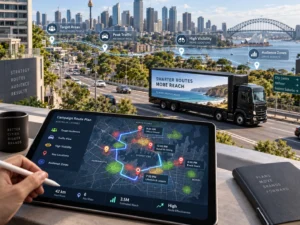
Ask what route is planned and why those specific streets were chosen over the alternatives. Route planning can use audience density, event proximity, and heatmap-led performance data to identify the strongest locations for campaign activity.
Mobile Marketing Australia’s LUMOS Intelligence partnership adds location intelligence that can help concentrate campaign activity around the highest-performing areas rather than relying on availability alone.
Question 2: What Campaign Days and Time Blocks Are Locked In?
Ask what campaign days and time blocks are locked in once the booking is confirmed. Mobile Marketing Australia campaigns run on a 4-hour or 8-hour media day, and clients can set exact timing to target morning traffic, lunchtime crowds, or evening commuters. Campaign days can also be distributed across multiple weeks or cities when the campaign requires broader geographic or timing coverage.
Question 3: Can Creative Rotate Mid-Flight?
Ask whether creative can rotate mid-flight and how quickly updated artwork can be deployed. A campaign that cannot adjust its messaging after launch becomes less responsive when an offer changes or one segment of the route clearly outperforms another.
Question 4: What Happens If a Route Underperforms in the Opening Days?
Ask how route performance is reviewed once the campaign is live and whether location data can inform subsequent route decisions. Heatmap data gives the campaign team a clearer basis for comparing locations and refining where campaign activity is concentrated.
Confirm Carbon Reporting Is Standard, Not a Marketing Page
Sustainability disclosure is becoming a procurement requirement, not just a nice-to-have. Therefore, look for 3 proof points:
- A documented carbon offset partnership,
- Solar-powered equipment options where the brief allows
- A reporting line that shows the environmental impact of your specific campaign, not just the company’s general claims.
Mobile Marketing Australia is 100% Carbon Neutral through its partnership with Greenfleet, so every campaign booked directly supports certified carbon offsetting rather than an unverified sustainability claim. If a shortlisted vendor treats sustainability as a static webpage with no reporting tied to your activation, that’s worth raising before you sign.
Check Exactly What Is Included in the Campaign
A strong proposal makes the campaign scope clear before anything is confirmed. Compare vendors based on what they actually deliver, including route planning, creative support, campaign tracking, proof-of-performance photography, audience reporting, and post-campaign analysis.
Confirm the Campaign Scope
Ask exactly what the proposed campaign includes. The format, operating hours, locations, campaign dates, creative requirements, and reporting deliverables should all be documented clearly.
Check Measurement and Reporting
Confirm whether GPS tracking, heat maps, verified audience insights, audience reporting, and daily campaign photography form part of the campaign delivery. Also establish whether audience activation can continue through publisher retargeting or ID pass-back where the campaign brief requires it.
Check Creative and Operational Support
Ask what happens when artwork changes, campaign timing shifts, or route conditions require an adjustment. A capable outdoor advertising partner explains how these changes are handled before the campaign begins.
Compare Deliverables, Not Just Proposals
Two campaigns using similar billboard formats can deliver very different levels of planning, tracking, reporting, and account support. Compare the complete campaign scope to understand what each outdoor advertising company will actually manage from briefing through to final reporting.
Read the Contract for the Clauses That Cause Disputes
Most conflicts between brands and outdoor advertising companies trace back to 3 specific terms nobody reads until something goes wrong. A confident outdoor advertising company walks you through all 3 before a contract is signed, not after a dispute forces the conversation.
Clause 1: Makegoods
Makegoods cover what happens if a screen fails or a vehicle is unavailable mid-campaign. The contract should spell out a written replacement timeframe or bonus exposure to offset the lost days.
Clause 2: Creative Approval and Turnaround
This clause should state how many revision rounds are included, the cutoff date before the campaign flight begins, and how late-stage creative changes are handled.
Clause 3: Cancellation and Reschedule Terms
Cancellation and reschedule terms matter most for event-tied bookings, where the event date itself shifts. A 4-week minimum notice period is standard practice for mobile campaigns.
Review Case Studies, Then Request a Live Reference
A case study is marketing material. A reference call is evidence. When you get a prior client on the phone, ask 3 things: did the campaign deliver the numbers stated in the post-campaign report, how did the vendor handle the one issue that came up mid-flight, and would they book the same company again.
Mobile Marketing Australia has run campaigns for Woolworths, Sportsbet, and the NRL, among other recognisable Australian brands. References are available on request ahead of any signed agreement.
Confirm Who Owns the Client Relationship
Larger OOH agencies route a brief through a sales representative, then an account manager, then a separate reporting analyst. Each handoff is a place where campaign context can get lost. For campaigns that require quick decisions and frequent coordination, that layered structure can slow communication and separate the client from the people making operational decisions.
A founder-led or senior-led outdoor advertising company keeps one accountable contact in the conversation from the first brief through to the final report. That shortens response time and cuts the risk of instructions getting lost between departments.
| Vendor discovery call | Focus ratio | Audience/brief questions over inventory pitching |
| Measurement partnership | Audience and activation data | Verified age, gender and interest insights, 2,000+ publisher retargeting and ID pass-back |
| Post-campaign report | Minimum daily photos | 20+ high-resolution images |
| Fleet breadth | Minimum format count | 5-8 distinct formats |
| MMA fleet | Total formats offered | 10 |
| Digital Mobile Billboard | Screen coverage | 20m² P4 LED (3 sides) |
| Media day structure | Time blocks | 4-hour or 8-hour blocks |
| Carbon offset partner | Certification level | 100% Carbon Neutral (Greenfleet) |
| Campaign reporting | Tracking evidence | GPS data, heat maps and campaign photography |
| Campaign scope | Key inclusions | Route, timing, creative requirements and reporting |
| Multi-Week Campaign | Day Rate | Quoted individually per campaign |
| Cancellation notice | Standard minimum | 4 weeks |
Campaign recommendations should reflect the audience, objective, route, timing, creative format, verified audience data, and location performance identified through heatmap-led planning.
Quick Vetting Checklist
A vetting checklist is a fixed set of criteria you confirm before signing with any vendor. Skip it, and you end up judging a company on its pitch instead of its proof, which is how underperforming campaigns get booked. Verify these 9 items before you sign with any outdoor advertising company.
- Brief-led discovery rather than inventory-first pitching
- Verified audience and campaign measurement, including audience insights, heatmap data and a sample report provided on request
- A minimum of 5 formats across mobile and fixed options
- Documented route and daypart strategy with mid-flight optimisation available
- Carbon offset reporting included by default
- Clear campaign scope, with format, route, timing, creative requirements, measurement, and reporting documented before confirmation
- Makegood terms confirmed in writing
- Cancellation terms confirmed in writing
- Direct access to a senior decision-maker throughout the campaign, backed by at least one live client reference in a comparable industry
Frequently Asked Questions
What questions should I ask a mobile billboard advertising company before signing?
Ask how audience data is verified, whether the campaign supports retargeting or ID pass-back, how heatmap data informs location planning, what a sample post-campaign report contains, which formats the company directly owns, what the make-good policy covers if a screen or vehicle is unavailable, and who your day-to-day contact will be.
How do I know if a mobile billboard company is reliable?
Three checks help confirm it: a recent client reference you can call directly, a sample post-campaign report provided before you commit, and daily proof-of-performance photography included as standard, not an optional extra.
What’s the difference between a mobile billboard company and a media buying agency?
A mobile billboard company owns and operates its own fleet, so routing, scheduling, campaign delivery, and reporting come from one accountable source. A media buying agency coordinates inventory across multiple vendors, adding another layer between the advertiser and the operator responsible for route and creative execution.
How long does it take to launch a mobile billboard campaign in Australia?
Mobile OOH is one of the fastest formats to activate. Many campaigns launch within 24 to 48 hours of creative approval, compared with the multi-week or multi-month lead times premium fixed billboard sites in capital city CBDs can require.
Get Your Brand Moving on the Right Route
Three ways to move forward with Mobile Marketing Australia: call 1300 234 448 to speak directly with the team, email info@mobilemarketingau.com to submit a brief, or get in touch through our contact page to request a sample report before committing to anything. Start with a clear brief, a planned route, and reporting you can verify from day one. That’s our principle, and it’s what we keep up.