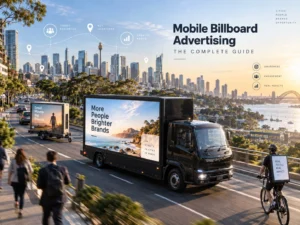
Over 74% of Australians see a billboard every single day.
But most people only picture one type when they hear the word “billboard.” That gap is exactly why so many campaigns end up picking the wrong format for the job.
Mobile billboard advertising in Australia spans 9 distinct formats. Large-scale digital trucks. Pedestrian-level walking boards. Long-term solar trailers. Each one suits a different audience, campaign objective, location, and campaign length, and choosing right starts with knowing what each format actually does.
This guide breaks down all 9, so your next call is based on clarity, not guesswork.
A Quick Look At Different Mobile Billboard Formats
| Format | Movement | Content Type | Best For |
| Digital Mobile Billboards | Moving (truck) | Digital, rotating | Product launches, promotions |
| Traditional Mobile Billboards | Moving (truck) | Static, single message | Single-message brand campaigns |
| Solar Ad Trailers | Fixed, relocatable | Static, rotating artwork | Long-term, off-grid visibility |
| Relocatable Billboards | Fixed, relocatable | Static, rotating artwork | “Set and forget” highway exposure |
| Digital Bike Boards | Moving (bike) | Digital, motion | Events, nightlife, pedestrian zones |
| Bike Board | Moving (bike) | Static | Local, single-message campaigns |
| Digital Walking Boards | Moving (foot) | Digital, motion | Promotions with ambassador interaction |
| Walking Boards | Moving (foot) | Static | Short local, foot-traffic campaigns |
| LED Poster Screens | Fixed location | Digital, static/video | Shopping centres, transport hubs, events |
Let’s take a closer look at all nine of them.
1. Digital Mobile Billboards
Big, bright, and hard to miss.
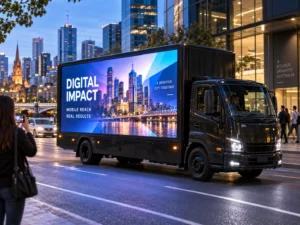
Digital Mobile Billboards use 20m² of high-definition P4 LED screen mounted across three sides of a truck, running animated, rotating visuals that stay bright day and night. This format supports unlimited artwork changes, GPS-tracked movement, and real-time content updates. That makes it a strong pick for product launches, retail promotions, and time-sensitive announcements, particularly campaigns where the message needs to change quickly.
2. Traditional Mobile Billboards
One message. One strong visual. Kept simple.
Traditional Mobile Billboards mount a large-format printed skin onto a truck, delivering the same classic, single-message impact as a static billboard, but on a moving route through your target audience. This format suits a consistent brand message that doesn’t need to change mid-campaign, making it a strong fit for businesses working with one clear creative across a defined route and campaign period.
3. Solar Ad Trailers
No power outlet needed. No daily driving required.
Solar Ad Trailers run entirely on solar power, giving 24/7 visibility without needing access to external electricity. This format displays static artwork on rotation and can sit in one spot for days, weeks, or months. Perfect for businesses after sustained, low-maintenance visibility rather than a daily-moving route, especially in areas with limited power infrastructure.
4. Relocatable Billboards
Set it up. Walk away. It keeps working.
Relocatable Billboards are two-sided units mounted on trailers, positioned in prime spots like busy highways or specific properties, then left to run on a “set and forget” basis. Once placed, this format delivers continuous exposure with zero ongoing effort, a practical choice for capturing commuters on a regular route.
5. Digital Bike Boards
Compact, agile, and built for pedestrian zones.
Digital Bike Boards are Australia’s first digital mobile billboards on two wheels, supporting JPEG, MP4, and GIF content. This format weaves through busy streets, events, and pedestrian zones that trucks simply can’t reach, putting your brand right in front of people at close range. Great for nightlife precincts, festivals, and events that need eye-catching motion content in pedestrian-heavy areas.
6. Bike Board
Same agility. Simpler build.
Bike Board is the static counterpart to the digital bike format, delivering the same eco-friendly, street-level reach without an LED screen. This format keeps the creative static while retaining the street-level mobility of the bike format, allowing campaigns to move through areas cars and trucks can’t reach. A good fit for local campaigns built around one clear message that doesn’t require rotating or animated content.
7. Digital Walking Boards
A screen. A person. Direct interaction.
Digital Walking Boards feature 480 x 790mm high-brightness LED screens carried directly by brand ambassadors through high-foot-traffic areas. This format supports both static and motion content, and because a real person carries the screen, it opens the door to direct interaction with the public alongside the visual message. Suits promotions, sampling activations, and events where a human presence adds to the brand.
8. Walking Boards
Same ambassador-carried reach, without the screen.
Walking Boards deliver the same pedestrian-level reach as the digital version, using static printed panels instead. The pedestrian-level format places static advertising directly within everyday foot traffic, especially across busy shopping strips. Works well for events, promotions, and short local campaigns with one clear message.
9. LED Poster Screens
Fixed in place. Always on.
LED Poster Screens are fixed-location digital displays built for indoor and outdoor spaces like shopping centres, transport hubs, gyms, and event venues. Unlike the other 8 formats, this one stays in one place instead of moving through a route. That makes it a strong fit for high-dwell locations where the same audience passes through again and again, supporting both static and video content.
Choosing the Right Type for Your Campaign
Match the format to the goal. Not to whichever option sounds most impressive.
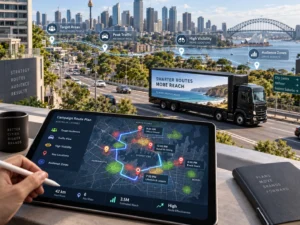
Campaign planning can also go beyond choosing the physical advertising format. Through Mobile Marketing Australia’s partnership with LUMOS Intelligence, campaigns can use verified audience insights covering age, gender and interests to better understand who is being reached. Heatmap-led planning can then identify the highest-performing locations, helping campaign activity focus on the areas with the strongest audience opportunity.
Campaign exposure can also continue beyond the street. LUMOS Intelligence supports retargeting across 2,000+ publishers, while ID pass-back can connect relevant audience data with a brand’s internal ecosystem for further campaign activation.
A multi-message retail promotion needs the rotating flexibility of a Digital Mobile Billboard. A brand presence that needs to stick around for months is better served by a Solar Ad Trailer or Relocatable Billboard. An event with a tight footprint and a young, mobile crowd gets more out of a Digital Bike Board or Digital Walking Board than a full-size truck.
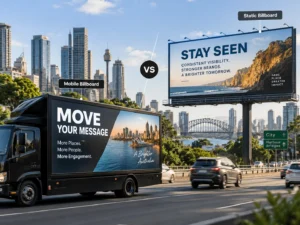
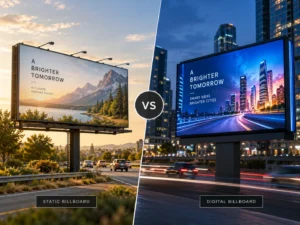
The strongest choice comes down to where the audience is, who that audience is, how the message needs to appear, how frequently the creative needs to change, whether the campaign requires movement or sustained placement, and what location data shows about audience opportunity. See how two major formats compare in our guide to static billboard vs digital billboard marketing.
Find the Right Format Before Your Competitor Does
Nine formats mean nine ways to get this wrong, if the decision comes down to gut feeling instead of a proper brief.
The businesses that win the best routes are the ones who move first.
A quick conversation is all it takes to match your audience, campaign objective, locations, and creative requirements to the right format before your ideal route gets booked by someone else. Let’s get your brand moving with Mobile Marketing Australia. Call 1300 234 448 and find out which of these 9 formats fits your next campaign.